Bass Fretboard
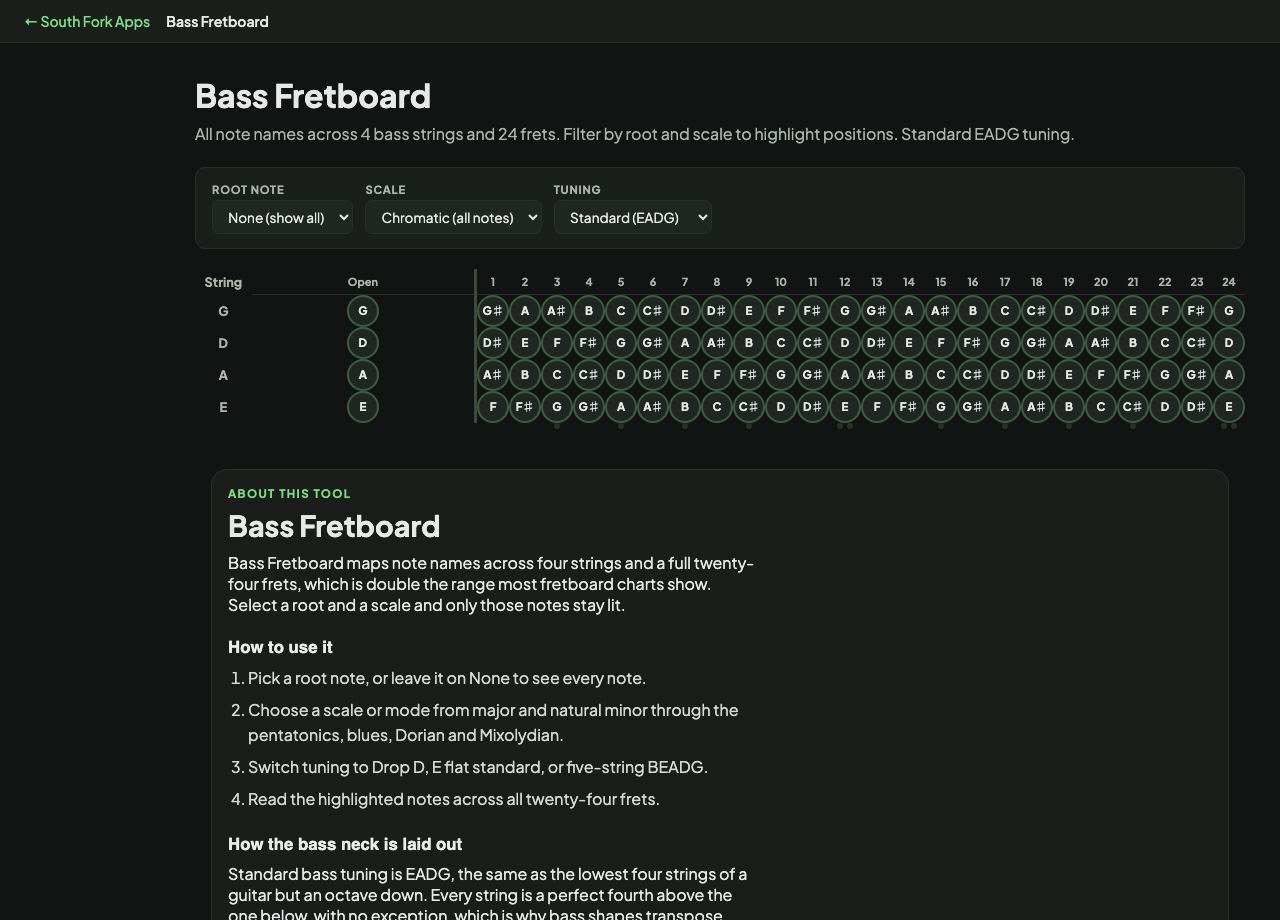
All note names across 4 bass strings and 24 frets. Filter by root and scale to highlight positions. Standard EADG tuning.
Bass Fretboard
Bass Fretboard maps note names across four strings and a full twenty-four frets, which is double the range most fretboard charts show. Select a root and a scale and only those notes stay lit.
How to use it
- Pick a root note, or leave it on None to see every note.
- Choose a scale or mode from major and natural minor through the pentatonics, blues, Dorian and Mixolydian.
- Switch tuning to Drop D, E flat standard, or five-string BEADG.
- Read the highlighted notes across all twenty-four frets.
How the bass neck is laid out
Standard bass tuning is EADG, the same as the lowest four strings of a guitar but an octave down. Every string is a perfect fourth above the one below, with no exception, which is why bass shapes transpose cleanly across the whole neck.
Twelve frets is one octave, so the note at fret 12 on any string is the open string an octave higher. Everything above fret 12 repeats the pattern below it.
Worked example
Locating the E minor pentatonic, the workhorse scale for rock and blues bass lines:
- Root NoteE
- ScaleMinor Pentatonic
- TuningStandard (EADG)
Result: Notes light up on the open E and around the twelfth fret, showing the same five notes (E G A B D) in two playable positions an octave apart.
When it helps
- Finding a scale in the upper register where most charts stop at fret 12.
- Checking what a five-string low B adds before you buy one.
- Working out a walking line that stays in key.
- Seeing which notes move when you drop to D.
What this tool handles
- The four-fourths tuning means every shape transposes without the fret shift guitarists deal with.
- Twenty-four frets covers two full octaves per string.
- Five-string BEADG adds a low B, extending the range down a fourth below the E.