About this tool
BMI Calculator
BMI Calculator works out Body Mass Index in imperial or metric units and places the result against the standard categories.
How to use it
- Choose imperial or metric units.
- Enter your height and weight.
- Read your BMI and its category.
The formula and its categories
BMI is weight in kilograms divided by height in metres squared. The imperial version multiplies pounds divided by inches squared by 703 to reach the same number.
The standard categories are: under 18.5 underweight, 18.5 to 24.9 normal, 25 to 29.9 overweight, and 30 and above obese.
Worked example
The default figures:
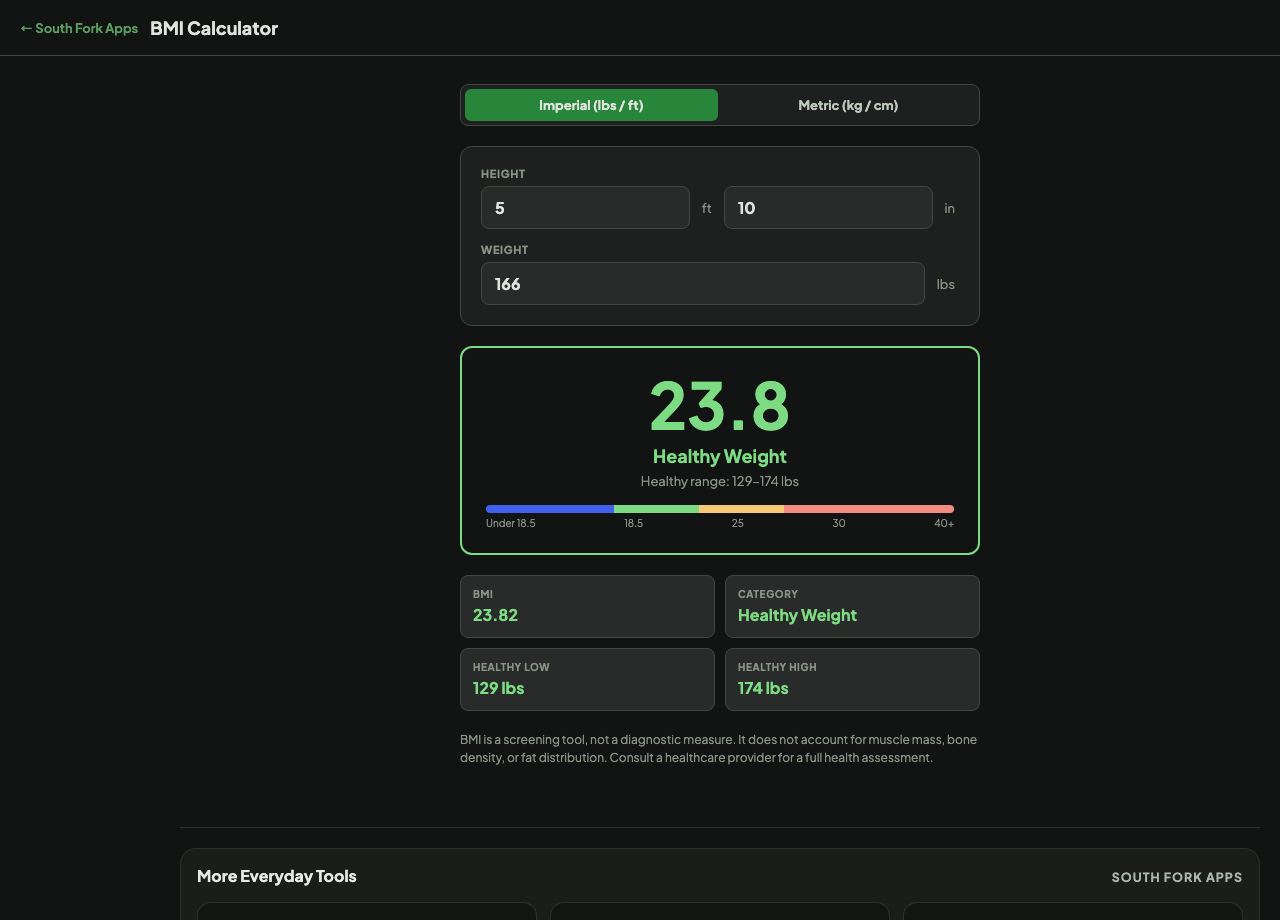
- Height5 ft 10 in
- Weight166 lbs
Result: A BMI of about 23.8, which falls in the normal range.
When it helps
- Getting a quick population-level reference point.
- Tracking a broad trend over months rather than days.
- Filling in a form that asks for BMI.
- Understanding a figure a clinician has quoted.
Common mistakes
- Treating BMI as a measure of health or body composition. It cannot distinguish muscle from fat, which is why many athletes register as overweight or obese while carrying very little fat.
- Applying adult categories to children, who use age and sex percentile charts instead.
- Reading a single number as a verdict. Waist measurement, blood markers and fitness all tell you more.
What this tool handles
- A general reference, not medical advice. BMI is a population screening tool and says little about any individual. Talk to a doctor about what your numbers mean.