About this tool
Break-Even Calculator
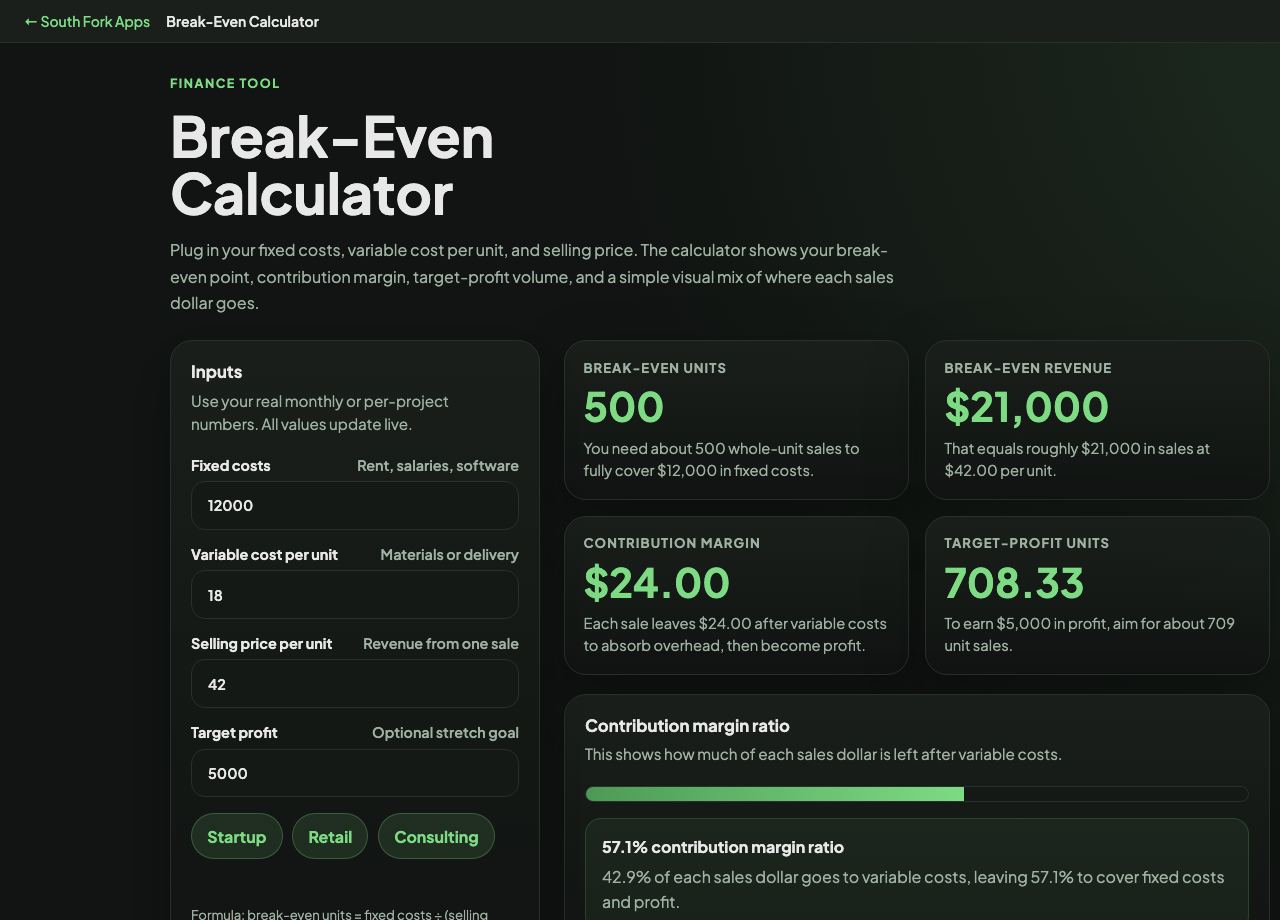
Break-Even Calculator finds how many units you need to sell before you stop losing money, from your fixed costs, variable cost per unit and selling price. It also handles a target profit, and has presets for startup, retail and consulting shapes.
How to use it
- Enter your fixed costs: rent, salaries, software, anything that does not change with volume.
- Enter the variable cost per unit and your selling price.
- Add a target profit if you want the volume needed to reach it, not just to break even.
- Try the Startup, Retail or Consulting presets to see typical shapes.
Contribution margin is the whole calculation
Every sale contributes its selling price minus its variable cost toward covering the fixed costs. That difference is the contribution margin, and break-even is simply fixed costs divided by it.
This is why raising price and cutting variable cost are so much more powerful than raising volume. A one dollar price rise adds a full dollar of contribution per unit, straight to the margin, while selling more units only adds one margin at a time.
Worked example
The default business:
- Fixed costs$12,000
- Variable cost per unit$18
- Selling price$42
- Contribution margin$24
Result: 500 units to break even. To also make the $5,000 target profit you need 709 units, because ($12,000 + $5,000) / $24.
When it helps
- Checking whether a business idea can work before committing money to it.
- Working out the minimum volume a price point requires.
- Seeing how much a price increase reduces the volume you need.
- Deciding whether a fixed-cost commitment like a lease or a hire is supportable.
Common mistakes
- Misclassifying costs. A cost that scales with sales is variable, not fixed, and putting it in the wrong column moves break-even substantially.
- Forgetting your own salary. If the plan does not pay you, it has not broken even.
- Treating break-even as the goal. It is the point where you stop losing money, not the point where the business works.