Chord Formulas
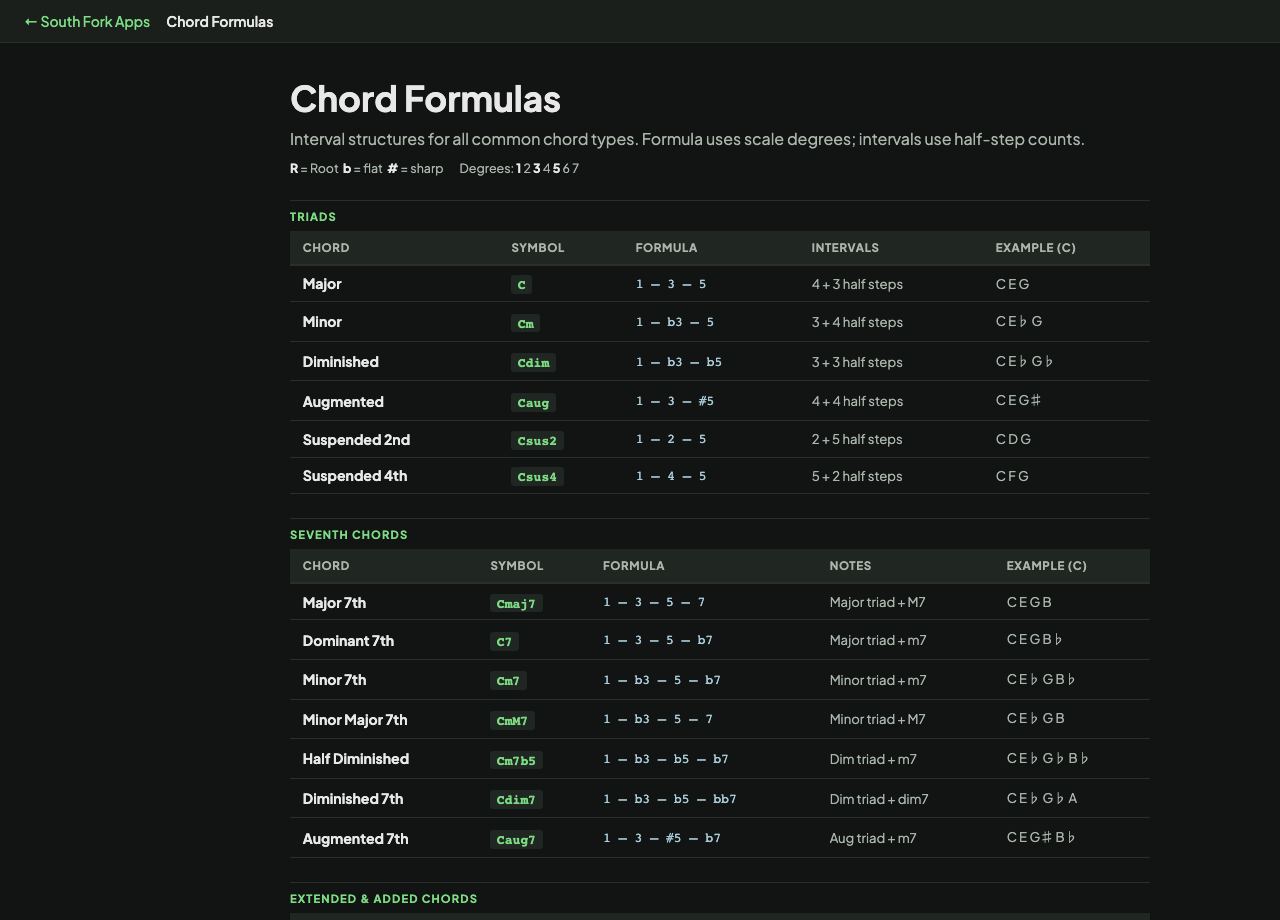
Interval structures for all common chord types. Formula uses scale degrees; intervals use half-step counts.
| Chord | Symbol | Formula | Intervals | Example (C) |
|---|---|---|---|---|
| Major | C | 1 – 3 – 5 | 4 + 3 half steps | C E G |
| Minor | Cm | 1 – b3 – 5 | 3 + 4 half steps | C E♭ G |
| Diminished | Cdim | 1 – b3 – b5 | 3 + 3 half steps | C E♭ G♭ |
| Augmented | Caug | 1 – 3 – #5 | 4 + 4 half steps | C E G♯ |
| Suspended 2nd | Csus2 | 1 – 2 – 5 | 2 + 5 half steps | C D G |
| Suspended 4th | Csus4 | 1 – 4 – 5 | 5 + 2 half steps | C F G |
| Chord | Symbol | Formula | Notes | Example (C) |
|---|---|---|---|---|
| Major 7th | Cmaj7 | 1 – 3 – 5 – 7 | Major triad + M7 | C E G B |
| Dominant 7th | C7 | 1 – 3 – 5 – b7 | Major triad + m7 | C E G B♭ |
| Minor 7th | Cm7 | 1 – b3 – 5 – b7 | Minor triad + m7 | C E♭ G B♭ |
| Minor Major 7th | CmM7 | 1 – b3 – 5 – 7 | Minor triad + M7 | C E♭ G B |
| Half Diminished | Cm7b5 | 1 – b3 – b5 – b7 | Dim triad + m7 | C E♭ G♭ B♭ |
| Diminished 7th | Cdim7 | 1 – b3 – b5 – bb7 | Dim triad + dim7 | C E♭ G♭ A |
| Augmented 7th | Caug7 | 1 – 3 – #5 – b7 | Aug triad + m7 | C E G♯ B♭ |
| Chord | Symbol | Formula | Notes | Example (C) |
|---|---|---|---|---|
| Add 9 | Cadd9 | 1 – 3 – 5 – 9 | Major triad + 9th | C E G D |
| Major 9th | Cmaj9 | 1 – 3 – 5 – 7 – 9 | Cmaj7 + 9th | C E G B D |
| Dominant 9th | C9 | 1 – 3 – 5 – b7 – 9 | C7 + 9th | C E G B♭ D |
| Minor 9th | Cm9 | 1 – b3 – 5 – b7 – 9 | Cm7 + 9th | C E♭ G B♭ D |
| Major 11th | Cmaj11 | 1 – 3 – 5 – 7 – 9 – 11 | Cmaj9 + 11th | C E G B D F |
| Dominant 11th | C11 | 1 – 3 – 5 – b7 – 9 – 11 | C9 + 11th | C E G B♭ D F |
| Major 13th | Cmaj13 | 1 – 3 – 5 – 7 – 9 – 11 – 13 | Cmaj11 + 13th | C E G B D F A |
| Dominant 13th | C13 | 1 – 3 – 5 – b7 – 9 – 11 – 13 | C11 + 13th | C E G B♭ D F A |
Chord Formulas
Chord Formulas is a reference chart for how chords are built, from basic triads through seventh chords and extensions. Each entry gives the interval formula so you can construct the chord from any root.
Reading a chord formula
A formula lists scale degrees relative to the major scale of the root. 1-3-5 is a major triad. Flattening the third gives 1-b3-5, a minor triad. Flattening the fifth as well gives 1-b3-b5, diminished.
Seventh chords add a fourth degree. 1-3-5-7 is a major seventh, 1-3-5-b7 is a dominant seventh, and 1-b3-5-b7 is a minor seventh. Extensions past the seventh (9, 11, 13) continue stacking thirds beyond the octave.
Worked example
Building an A dominant seventh from the formula:
- Formula1 - 3 - 5 - b7
- A major scaleA B C# D E F# G#
- Applying it1=A, 3=C#, 5=E, b7=G
Result: A, C sharp, E, G. The flattened seventh is what makes it sound like blues rather than a resolved major seventh.
When it helps
- Constructing a chord on any instrument when you know the root.
- Understanding what a chord symbol is actually asking for.
- Working out which note to alter when a chart says something like 7#9.
- Learning why some chords sound tense and others resolved.
Common mistakes
- Reading the numbers as scale steps of the key rather than of the chord's own root. Formulas are always relative to the root's major scale.
- Assuming a 9 chord contains a 7. By convention it does, and a chord with a 9 but no 7 is written add9.