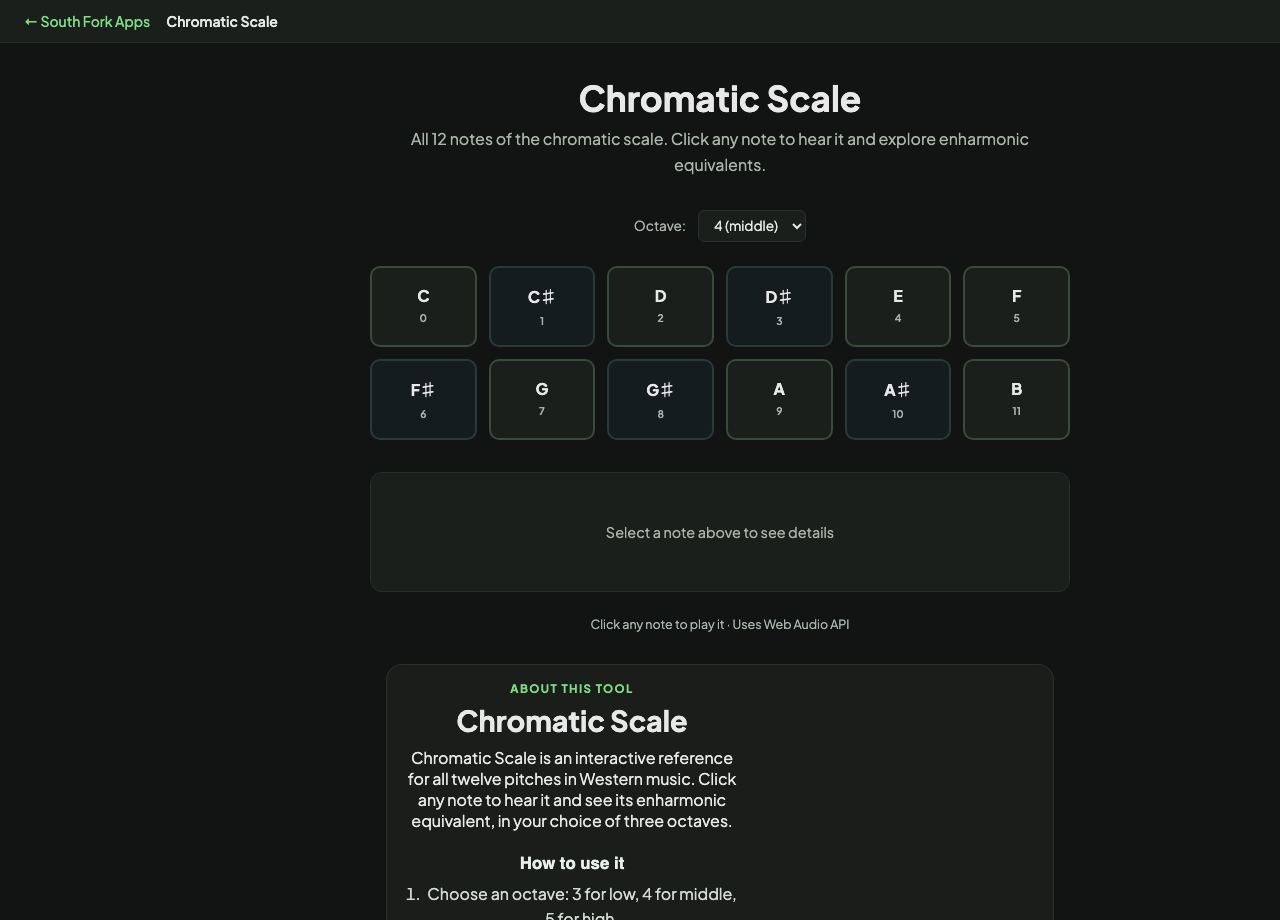
Chromatic Scale
All 12 notes of the chromatic scale. Click any note to hear it and explore enharmonic equivalents.
Select a note above to see details
Chromatic Scale
Chromatic Scale is an interactive reference for all twelve pitches in Western music. Click any note to hear it and see its enharmonic equivalent, in your choice of three octaves.
How to use it
- Choose an octave: 3 for low, 4 for middle, 5 for high.
- Click any of the twelve notes to hear it.
- Read the enharmonic equivalent shown alongside each altered note.
Twelve notes, more than twelve names
Western music divides the octave into twelve equal semitones. Play all twelve in order and you have the chromatic scale, which is the raw material every other scale is carved out of.
Five of those twelve have two names each. C sharp and D flat are the same key on a piano but are written differently depending on the key you are in. Sharps are used when a note is rising, flats when it is falling, which is why the same pitch changes name between contexts.
Worked example
The chromatic scale starting on C:
- AscendingC, C#, D, D#, E, F, F#, G, G#, A, A#, B
- Descending equivalentsDb, Eb, Gb, Ab, Bb
Result: Twelve pitches, seven letter names, and five notes that carry two spellings each.
When it helps
- Hearing the difference between a semitone and a whole tone.
- Checking which enharmonic spelling belongs in a given key.
- Learning where the semitones fall between E and F, and between B and C, where there is no black key.
- Ear training on individual pitches.
Common mistakes
- Assuming every letter has a sharp. E sharp is F and B sharp is C, because those pairs are already only a semitone apart.
- Treating enharmonics as interchangeable in notation. They sound identical but only one spelling is correct in a given key.