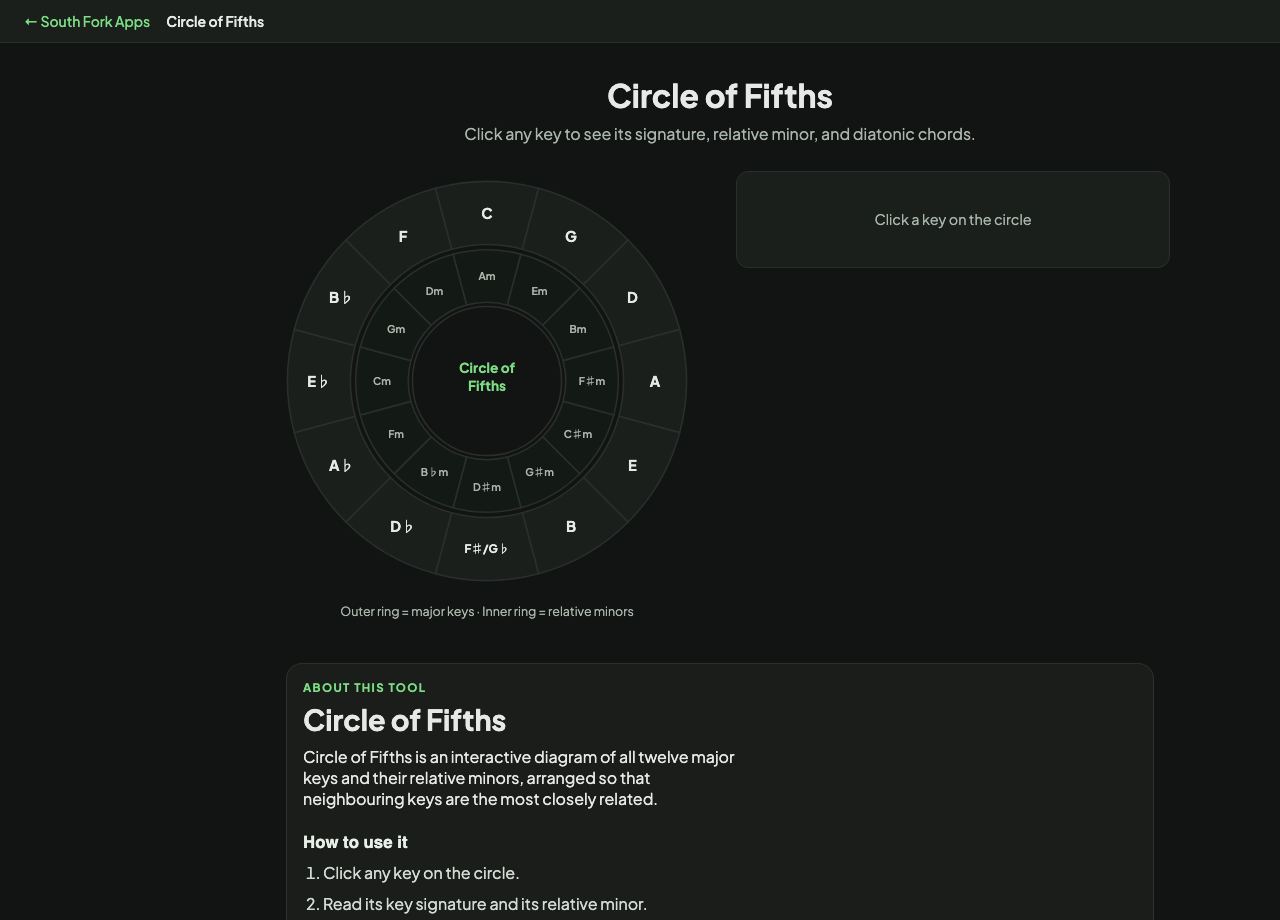
Circle of Fifths
Click any key to see its signature, relative minor, and diatonic chords.
Outer ring = major keys · Inner ring = relative minors
Click a key on the circle
Circle of Fifths
Circle of Fifths is an interactive diagram of all twelve major keys and their relative minors, arranged so that neighbouring keys are the most closely related.
How to use it
- Click any key on the circle.
- Read its key signature and its relative minor.
- Follow the circle clockwise or counter-clockwise to see related keys.
Why the order is what it is
Moving clockwise goes up a perfect fifth each step: C, G, D, A, E, B, F sharp. Each step adds exactly one sharp to the key signature. Moving counter-clockwise goes up a fourth and adds one flat: C, F, B flat, E flat, A flat, D flat, G flat.
That gives the circle its practical value. Keys next to each other share all but one note, so modulating to a neighbour is smooth and modulating across the circle is jarring. The relative minor sits inside each major, sharing the same key signature.
Worked example
Reading the circle from C:
- One step clockwiseG major, one sharp
- One step counter-clockwiseF major, one flat
- Inside CA minor, no accidentals
Result: C, G and F share six of their seven notes, which is why the I, IV and V chords sound like they belong together.
When it helps
- Finding which keys are closely related for a modulation.
- Working out a key signature without memorising all fifteen.
- Understanding why certain chord progressions feel inevitable.
- Finding the relative minor of any major key.
Common mistakes
- Reading the circle as a ranking. It is a map of relatedness, not of difficulty or quality.
- Forgetting the enharmonic overlap at the bottom, where F sharp major and G flat major are the same pitches spelled differently.
- Assuming distant keys cannot be used together. Distant modulation is a deliberate effect, not an error.