Clef Reference
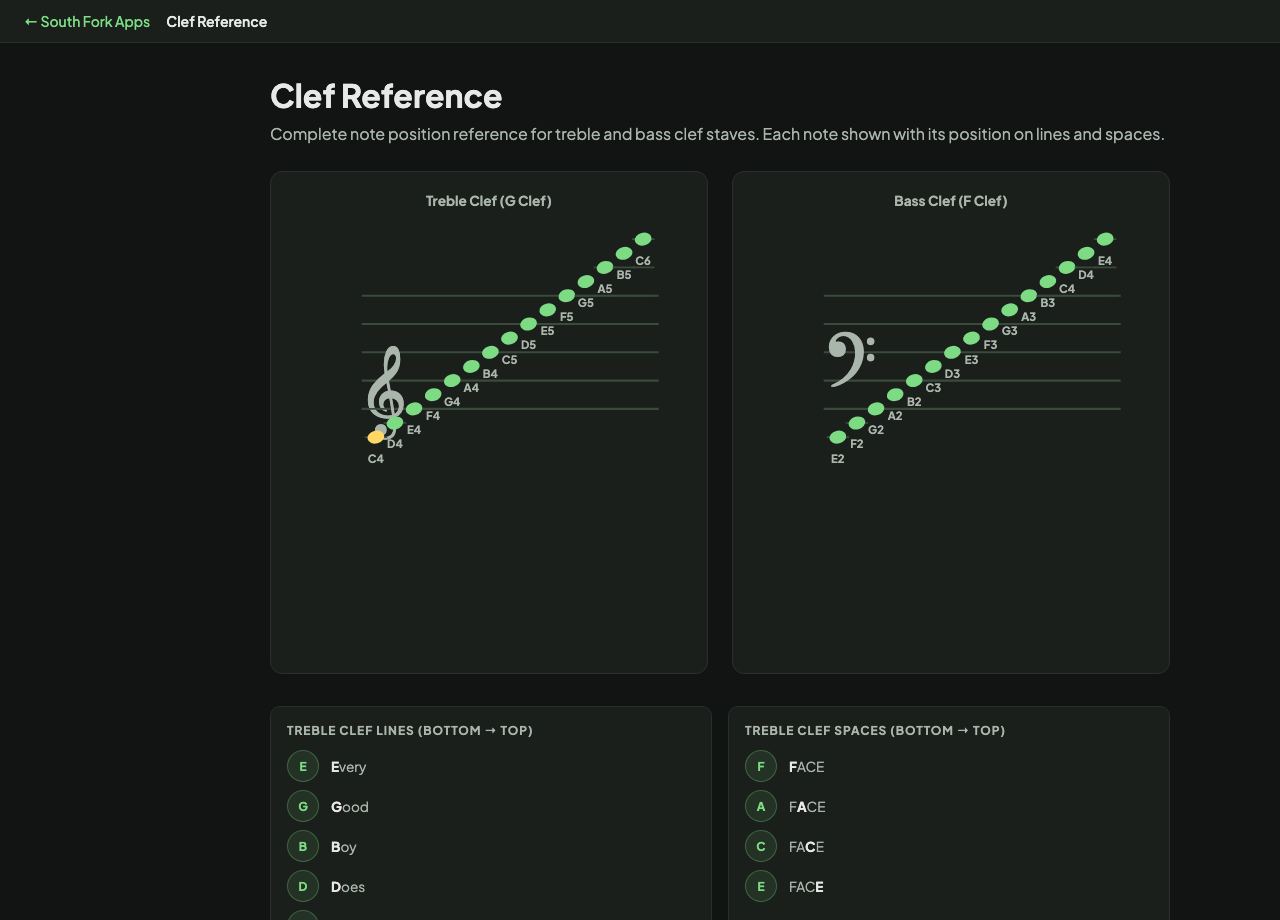
Complete note position reference for treble and bass clef staves. Each note shown with its position on lines and spaces.
| Note | Clef | Position | Description |
|---|---|---|---|
| Middle C (C4) | Both | 1 ledger below treble / 1 ledger above bass | The note that connects both staves |
| C3 | Bass | 1 ledger below bass | Low C on piano |
| C5 | Treble | 3rd space (no ledger) | Just above the staff |
| A5 | Treble | 1 ledger above treble | Violin open E string neighbor |
| G2 | Bass | 2 ledger lines below bass | Low G on bass guitar |
Clef Reference
Clef Reference maps every note position on both treble and bass staves, including the ledger lines above and below where most readers lose their footing.
Why there are two clefs at all
A staff has only five lines, which covers about an octave and a half before you need ledger lines. Two clefs positioned at different pitches let a piano's full range be written without stacking ledger lines that nobody can read at speed.
The clef symbol itself is a pointer. The treble clef curls around the line that is G above middle C. The bass clef's two dots sit either side of the line that is F below middle C. Every other note is counted from there.
Worked example
Locating the same pitch on both staves:
- On trebleone ledger line below the staff
- On bassone ledger line above the staff
Result: Both are middle C, the same key on the piano, written from the perspective of each clef.
When it helps
- Looking up a note position without working it out from a mnemonic.
- Learning ledger lines systematically instead of by trial and error.
- Switching between clefs when you play an instrument that uses both.
- Checking a note when transcribing.
What this tool handles
- Covers both clefs including ledger lines above and below each staff.
- Shows how the two staves overlap around middle C.