Common Chord Progressions
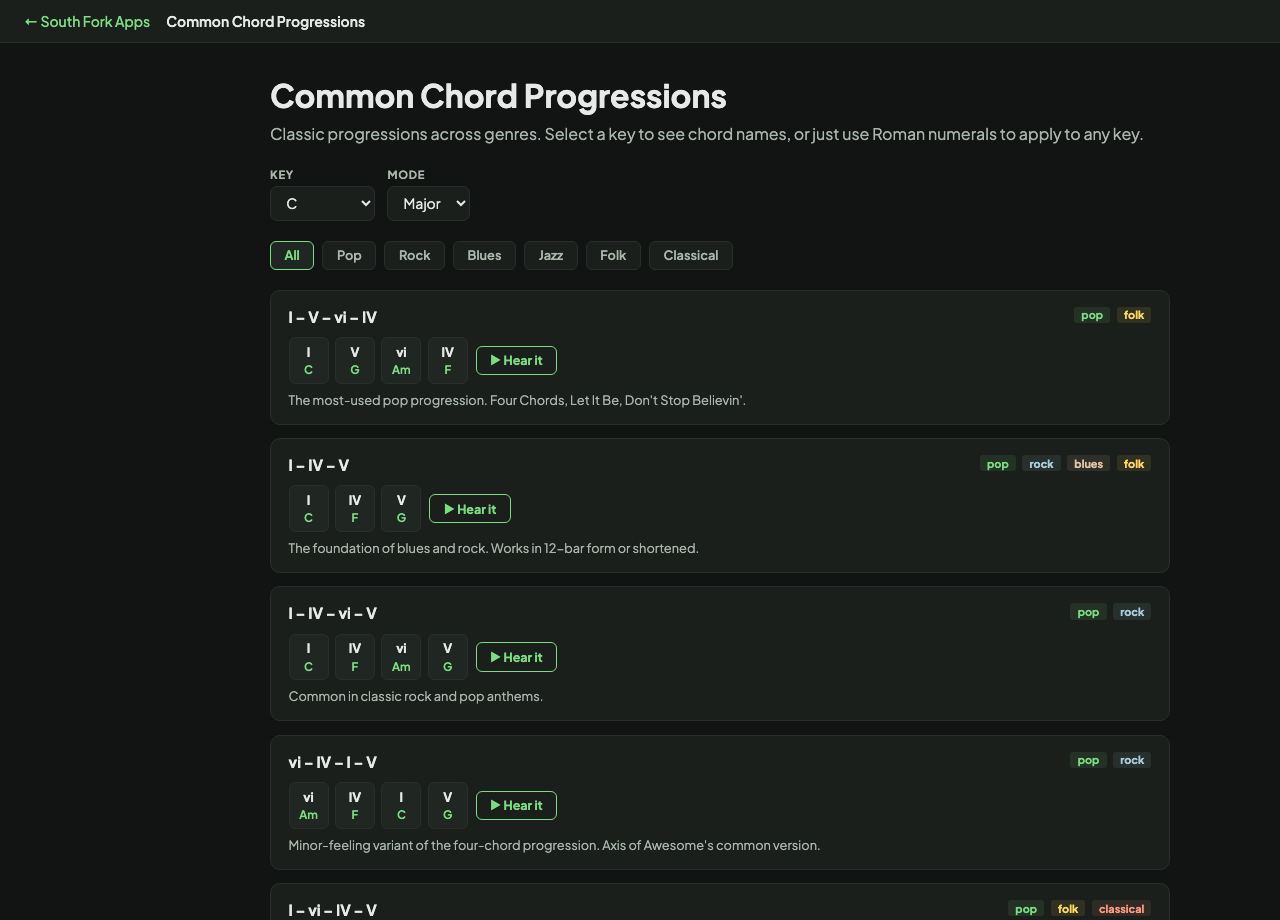
Classic progressions across genres. Select a key to see chord names, or just use Roman numerals to apply to any key.
Common Chord Progressions
Common Chord Progressions is a reference library of the progressions that actually get used, filtered by genre and transposed into any key. Each one is shown as Roman numerals and as real chord names.
How to use it
- Pick a key and a mode.
- Filter by genre: pop, rock, blues, jazz, folk or classical.
- Read each progression as Roman numerals and as chords in your chosen key.
Why Roman numerals instead of chord names
Roman numerals describe a progression by scale degree rather than by key, so I-V-vi-IV is the same progression whether you play it in C or in E. Uppercase means major, lowercase means minor.
That is what makes progressions portable. Once you know I-V-vi-IV, you can play it in any of the twelve keys by reading off the diatonic chords for that key.
Worked example
The four-chord progression behind a large share of pop music, in C:
- ProgressionI - V - vi - IV
- KeyC major
Result: C, G, Am, F. The same four numerals in G give G, D, Em, C.
When it helps
- Starting a song when a blank page is the problem.
- Recognising why two songs sound alike.
- Finding a genre-appropriate progression to practise over.
- Transposing a progression into a key that suits a singer.
What this tool handles
- Every progression is shown in both Roman numerals and real chord names for the selected key.
- Major and minor mode both have their own progression sets.