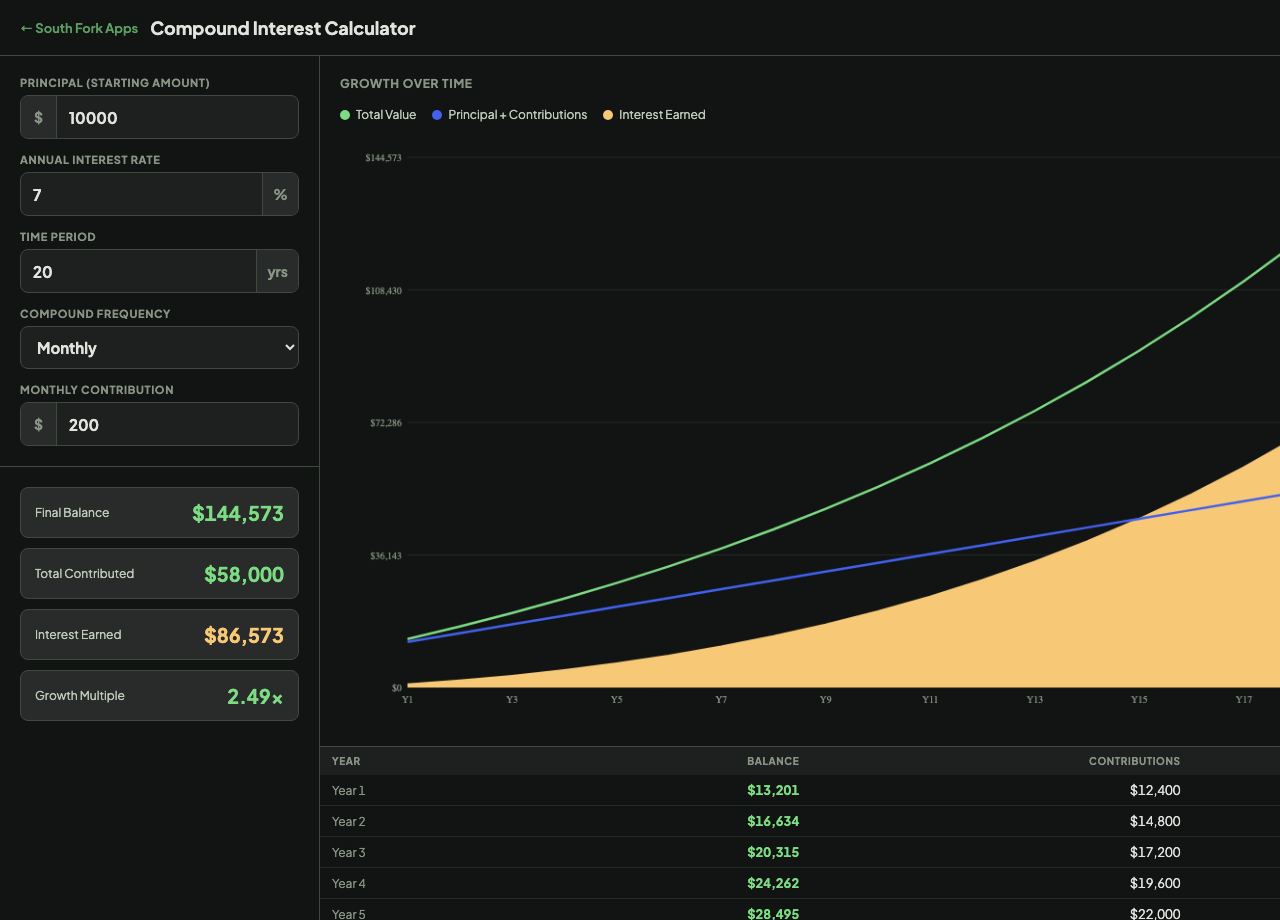
Growth Over Time
Total Value
Principal + Contributions
Interest Earned
| Year | Balance | Contributions | Interest |
|---|
| Year | Balance | Contributions | Interest |
|---|
Compound Interest Calculator projects what a starting balance grows to over time, with regular monthly contributions, a choice of compounding frequency, a growth chart and a year-by-year breakdown.
Simple interest pays only on the original principal. Compound interest pays on the principal plus everything it has already earned, so each period starts from a larger base. That is why the curve bends upward instead of running straight.
Compounding frequency matters less than people expect. Going from annual to monthly compounding at the same rate adds a fraction of a percent. What actually dominates the result is the rate, the time, and how much you keep adding.
Using the values the calculator loads with:
Result: About $137,000. Of that, $58,000 is money you put in and roughly $79,000 is growth. The growth overtakes the contributions somewhere around year twelve.
v1.0