Diatonic Scale
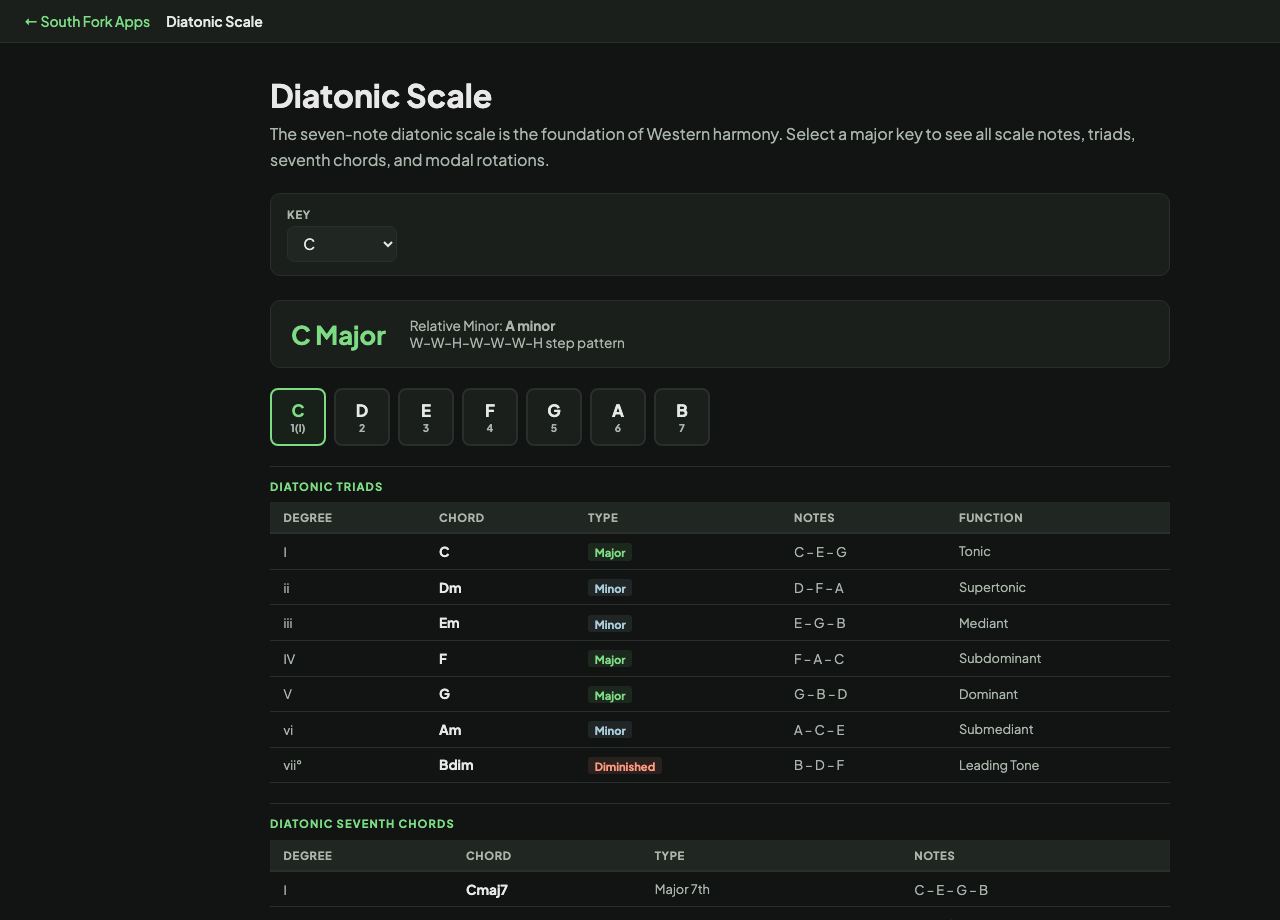
The seven-note diatonic scale is the foundation of Western harmony. Select a major key to see all scale notes, triads, seventh chords, and modal rotations.
| Degree | Chord | Type | Notes | Function |
|---|
| Degree | Chord | Type | Notes |
|---|
| Mode | Starting Note | Roman | Scale Notes | Character |
|---|
Diatonic Scale
Diatonic Scale is a full reference for any major key. Pick a key and it shows the seven scale notes, the triads built on each degree, the seventh chords, and the Roman numeral for every one.
How to use it
- Select a key.
- Read the seven scale notes in order.
- Read the triad and seventh chord built on each degree, with its Roman numeral.
The pattern that defines a major scale
Every major scale follows the same step pattern: whole, whole, half, whole, whole, whole, half. That fixed pattern is what makes every major scale sound like a major scale regardless of which note you start on.
The chord qualities follow automatically from that pattern and never change: I major, ii minor, iii minor, IV major, V major, vi minor, vii diminished. You do not choose them, the scale hands them to you.
Worked example
Building G major from the step pattern:
- StartG
- StepsW W H W W W H
- NotesG A B C D E F#
Result: One sharp (F sharp), which is exactly what the key signature for G major shows.
When it helps
- Seeing every chord available in a key at once.
- Understanding why a particular note has to be sharpened or flattened.
- Finding the seventh chords when a triad sounds too plain.
- Learning Roman numeral analysis on real keys.
Common mistakes
- Counting the semitone steps wrong between the third and fourth degrees. That half step is what separates major from every other mode.
- Forgetting that the eighth note is the first one again, an octave up, so a scale has seven distinct notes and not eight.