← South Fork Apps

Dice Roller

Modifier +0
About this tool

Dice Roller

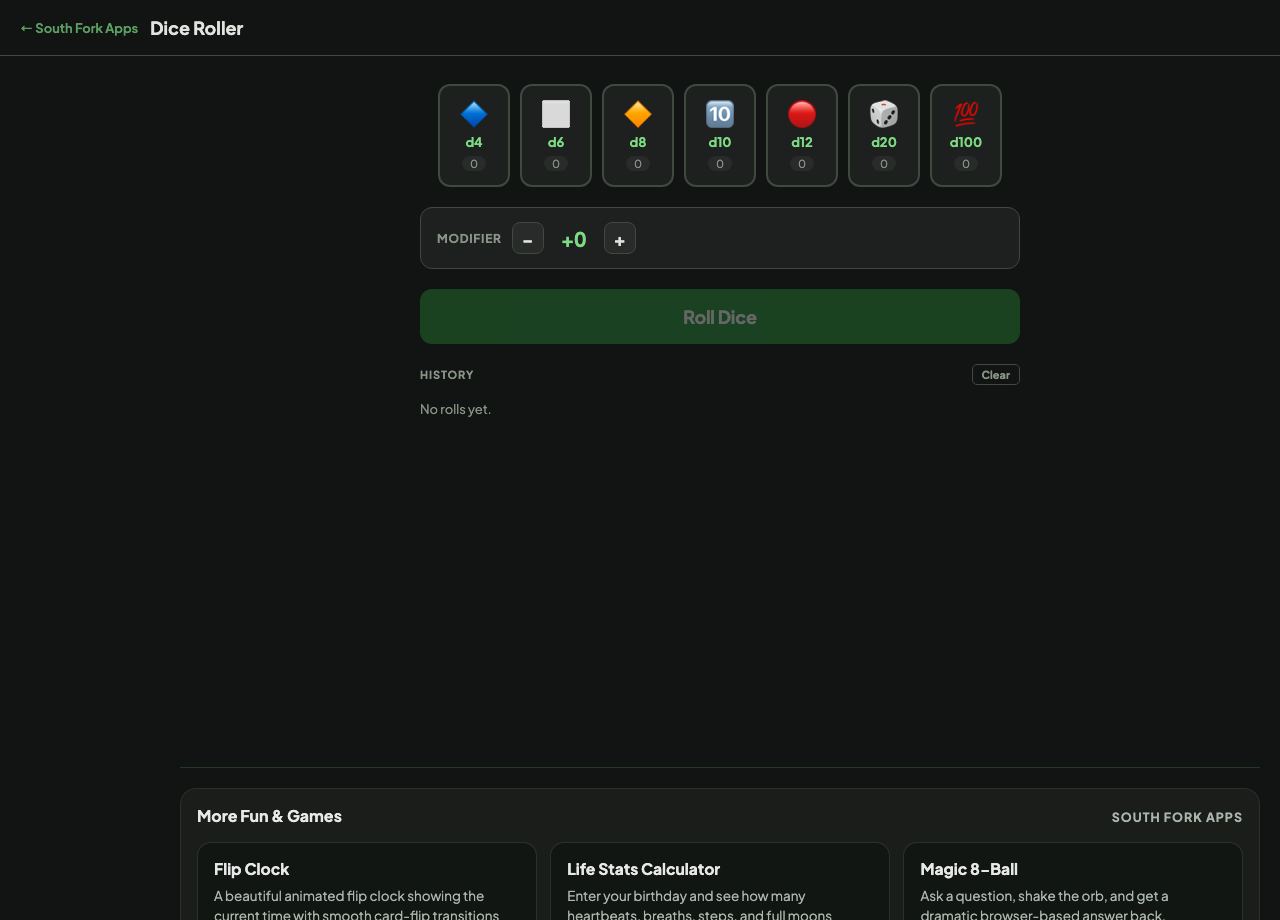
Dice Roller rolls d4, d6, d8, d10, d12, d20 and d100 with modifiers, keeping a history of your rolls.

How to use it

  1. Choose a die type and how many to roll.
  2. Add a modifier if you need one.
  3. Roll, and read the result and the running history.

Why one die and several dice behave differently

A single die is uniform: every face is equally likely, so a d20 is as likely to roll 1 as 20. That flatness is exactly why d20 systems feel swingy, because a skilled character still fails often.

Rolling several dice and summing them is not uniform. Two d6 produce a triangular distribution peaking at 7, which comes up six times more often than 2 or 12. Three or more dice tend toward a bell curve, which is why systems using 3d6 produce far more predictable results than a single d20.

Worked example

Why 7 dominates on 2d6:

  • Ways to roll 21 (1+1)
  • Ways to roll 76 (1+6, 2+5, 3+4, and reverses)
  • Ways to roll 121 (6+6)

Result: Seven is six times more likely than either extreme, which is the whole basis of craps odds.
When it helps

  • Playing tabletop RPGs without physical dice.
  • Rolling large handfuls quickly.
  • Board games with a lost die.
  • Generating random numbers in a range with a familiar interface.

Common mistakes

  • Expecting past rolls to influence future ones. Dice have no memory, and a run of low rolls does not make a high one due.
  • Assuming a d20 system is fair because the die is uniform. Uniform means swingy, not balanced.
  • Reading a short history as a pattern. Small samples look streaky even when perfectly random.
Dice Roller interface preview
Screenshot of the live Dice Roller interface.

v1.0