Guitar Fretboard
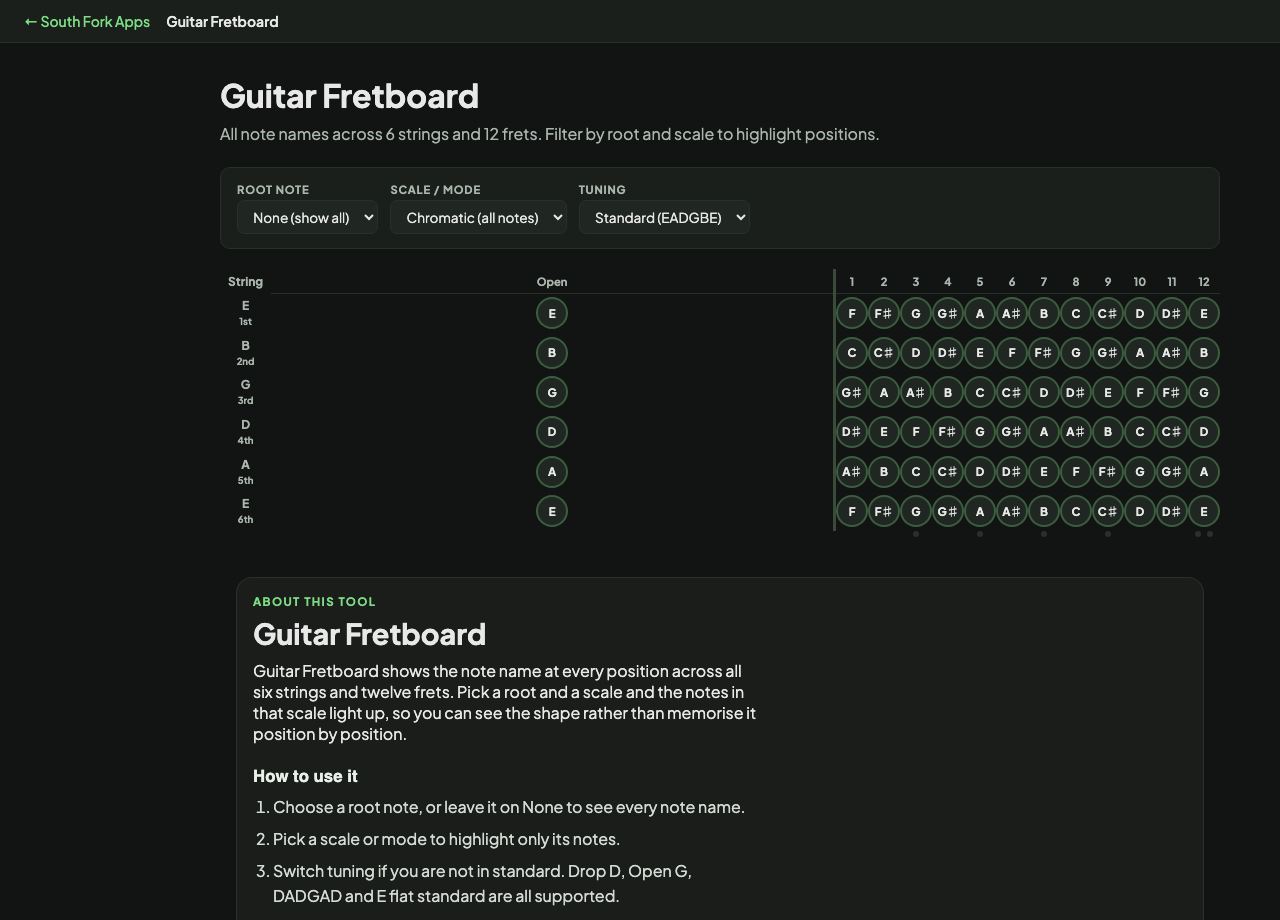
All note names across 6 strings and 12 frets. Filter by root and scale to highlight positions.
Guitar Fretboard
Guitar Fretboard shows the note name at every position across all six strings and twelve frets. Pick a root and a scale and the notes in that scale light up, so you can see the shape rather than memorise it position by position.
How to use it
- Choose a root note, or leave it on None to see every note name.
- Pick a scale or mode to highlight only its notes.
- Switch tuning if you are not in standard. Drop D, Open G, DADGAD and E flat standard are all supported.
- Read the shapes across the neck and find the same scale in more than one position.
Why the shapes repeat
Standard tuning is EADGBE from the low string up. Every string is a perfect fourth above the one below it, except the B string, which is a major third above the G. That single exception is why chord and scale shapes shift by one fret once they cross to the top two strings.
Because the guitar is tuned in mostly even intervals, one scale shape works for every root. Move the shape up two frets and you have moved the key up a whole tone, which is why guitarists talk about positions instead of note names.
Worked example
Finding the A minor pentatonic box, the first shape most players learn:
- Root NoteA
- ScaleMinor Pentatonic
- TuningStandard (EADGBE)
Result: The highlighted notes cluster at the fifth fret, giving the familiar two-note-per-string box that runs A C D E G.
When it helps
- Learning where a scale actually sits instead of memorising one box shape.
- Finding the same notes higher up the neck so you can solo past the fifth fret.
- Checking which notes change when you drop to an alternate tuning.
- Working out the note under your finger when you are reading a chord chart.
Common mistakes
- Assuming a shape transposes cleanly across the G and B strings. That major third breaks the pattern and shifts everything one fret.
- Learning only one pentatonic box. The same five notes exist in five positions and the neck opens up when you connect them.
- Forgetting that changing tuning changes every note name on the neck, not just the string you retuned.