Guitar Tuning Chart
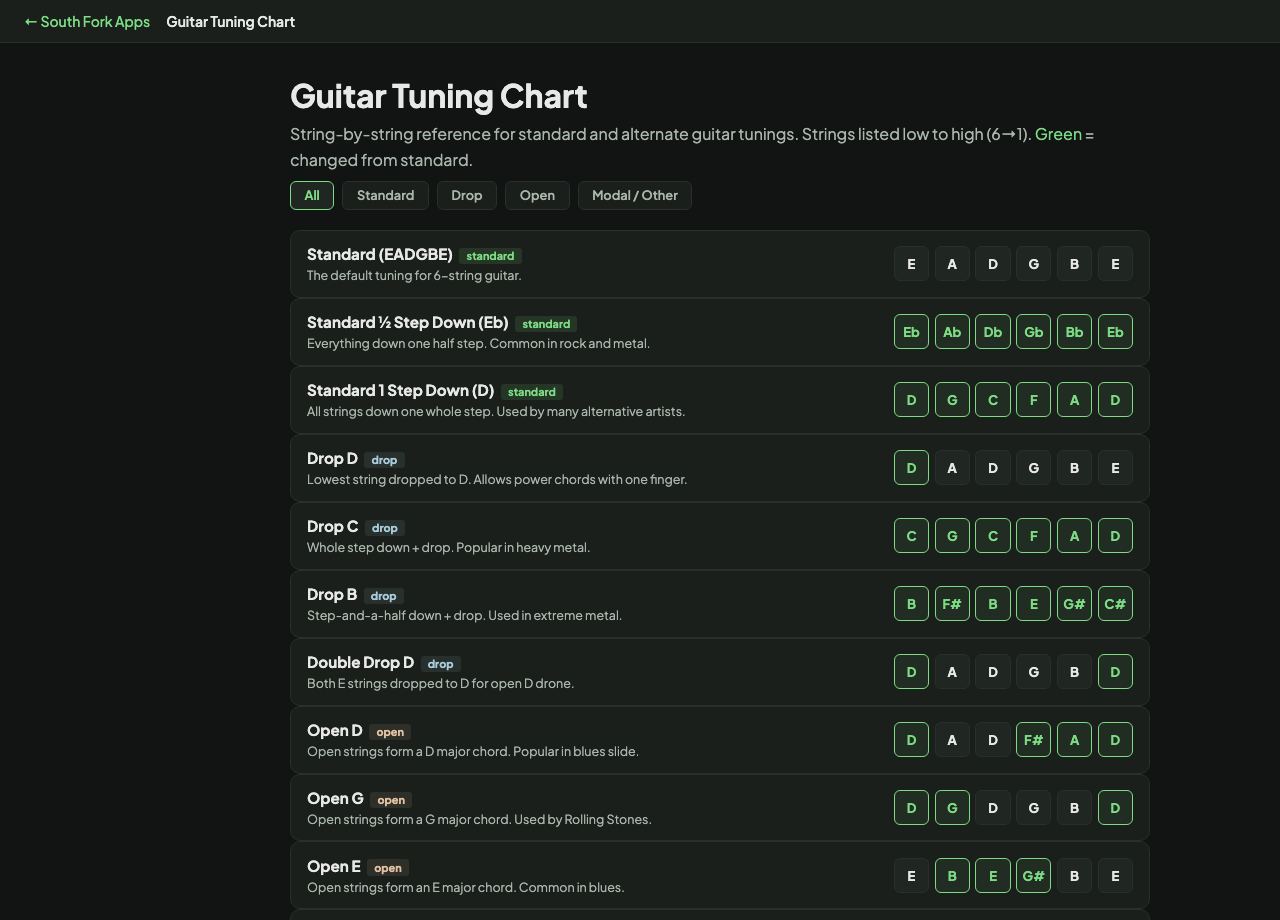
String-by-string reference for standard and alternate guitar tunings. Strings listed low to high (6→1). Green = changed from standard.
Guitar Tuning Chart
Guitar Tuning Chart lists the string-by-string notes for standard and alternate tunings, grouped into standard, drop, open and modal categories.
How to use it
- Filter by category, or view all tunings.
- Read the six string notes from low to high for each tuning.
What each family of tuning is for
Standard is EADGBE from the lowest string up. Drop tunings lower the sixth string only, so Drop D is DADGBE, which lets a power chord be played with one finger across the bottom three strings.
Open tunings retune the strings so the open guitar sounds a full chord. Open G is DGDGBD, which is why slide players use it: barring any single fret gives a complete major chord. Modal tunings like DADGAD avoid the third entirely, leaving a chord that is neither major nor minor and sits well under folk and Celtic playing.
Worked example
Comparing standard with Drop D:
- StandardE A D G B E
- Drop DD A D G B E
- Changesixth string down one whole tone
Result: One string moves. The low D lets you play a D5 power chord by barring the bottom three strings at one fret.
When it helps
- Retuning correctly for a song written in an alternate tuning.
- Choosing a tuning that suits slide or fingerstyle playing.
- Understanding why a familiar chord shape produces a different chord after retuning.
- Working out how far each string has to move before you start.
Common mistakes
- Tuning a string up too far. Raising pitch increases tension and is the usual way strings break.
- Expecting standard chord shapes to work in an open tuning. The whole point is that they do not.