Haiku Checker
Count syllables per line and check for the 5-7-5 pattern.
Haiku Checker
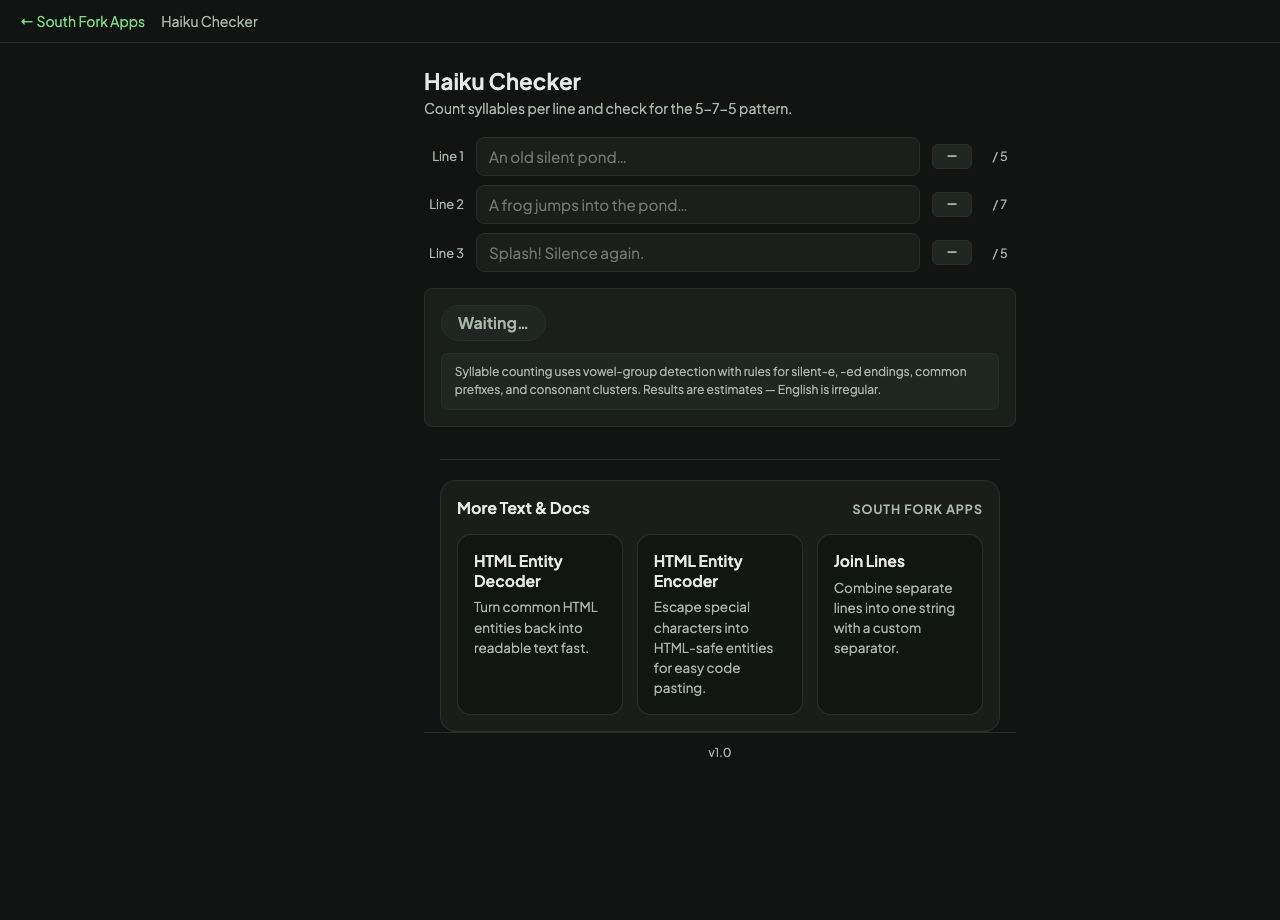
Haiku Checker counts syllables line by line and tells you whether your poem matches the 5-7-5 pattern. Type each line into its own field and the counts update as you write.
How to use it
- Type the first line and watch the syllable count.
- Fill in the second and third lines.
- Adjust wording until the counts read 5, 7 and 5.
How syllables are counted, and why it is imperfect
Syllable counting works by finding vowel groups in a word, then correcting for the common English exceptions: a silent final e, the -le ending that adds a syllable, and vowel pairs that form one sound rather than two.
English defeats any purely mechanical rule. Fire and flower are one or two syllables depending on your accent, and words like every are routinely compressed in speech. Treat the count as a strong guide and trust your ear where they disagree.
Worked example
The classic structure:
- Line 15 syllables
- Line 27 syllables
- Line 35 syllables
Result: Seventeen syllables total, the English convention adapted from the Japanese form.
When it helps
- Writing haiku without counting on your fingers.
- Teaching syllables and meter in a classroom.
- Checking a line quickly while drafting other poetry.
- Tightening prose, since syllable count is a decent proxy for how heavy a sentence reads.
Common mistakes
- Treating 5-7-5 as the definition of haiku. Traditional Japanese haiku counts on, which are not the same as English syllables, and many respected English haiku deliberately do not use 5-7-5.
- Trusting the counter over your own ear on ambiguous words like fire, hour and every.