Key Signatures
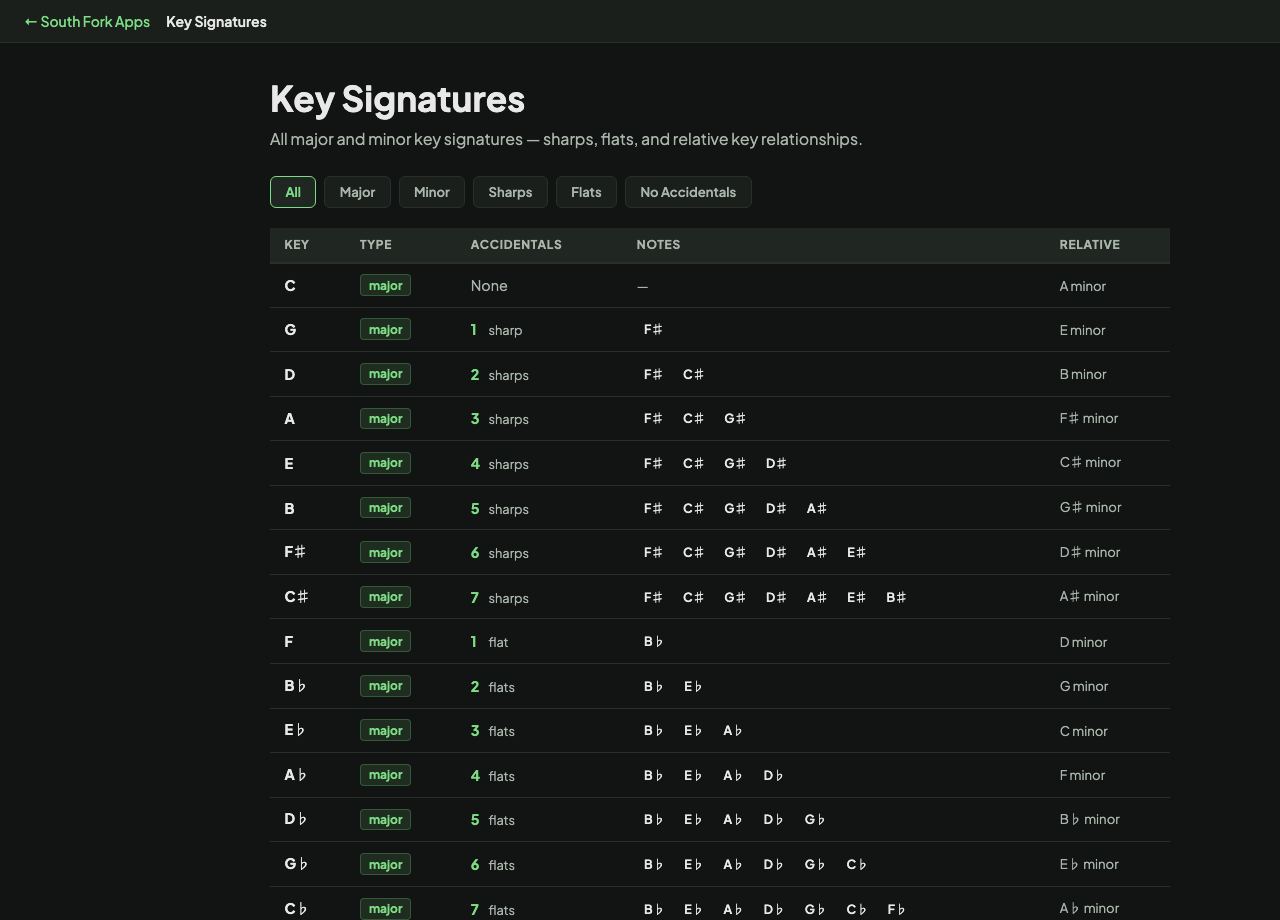
All major and minor key signatures — sharps, flats, and relative key relationships.
| Key | Type | Accidentals | Notes | Relative |
|---|
Key Signatures
Key Signatures is a complete reference for all thirty major and minor key signatures, showing the sharps or flats in each and how every major key pairs with its relative minor.
How to use it
- Filter by major, minor, sharps, flats, or no accidentals.
- Read the accidentals in each key signature and the relative key it shares them with.
The order of sharps and flats
Sharps always appear in the same order: F, C, G, D, A, E, B. Flats appear in exactly the reverse order: B, E, A, D, G, C, F. That order never changes, so a signature with three sharps is always F sharp, C sharp and G sharp.
To name a sharp key, take the last sharp and go up one semitone. Three sharps ends on G sharp, so the key is A major. For flat keys, the second-to-last flat is the key name, which is why four flats (B, E, A, D) is A flat major.
Worked example
Identifying a key signature with two sharps:
- Sharps presentF sharp, C sharp
- Last sharpC sharp
- Up one semitoneD
Result: D major, or its relative minor B minor. Both share the same two sharps.
When it helps
- Naming a key from the signature at the start of a piece.
- Finding the relative minor when a piece sounds minor but has a major signature.
- Checking which notes are sharpened or flattened before you sight-read.
- Learning the circle of fifths in a way that sticks.
Common mistakes
- Reading a signature as major without listening. A major key and its relative minor share an identical signature, and only the music tells you which it is.
- Forgetting that a key signature applies to every octave, not just the line or space where the symbol sits.