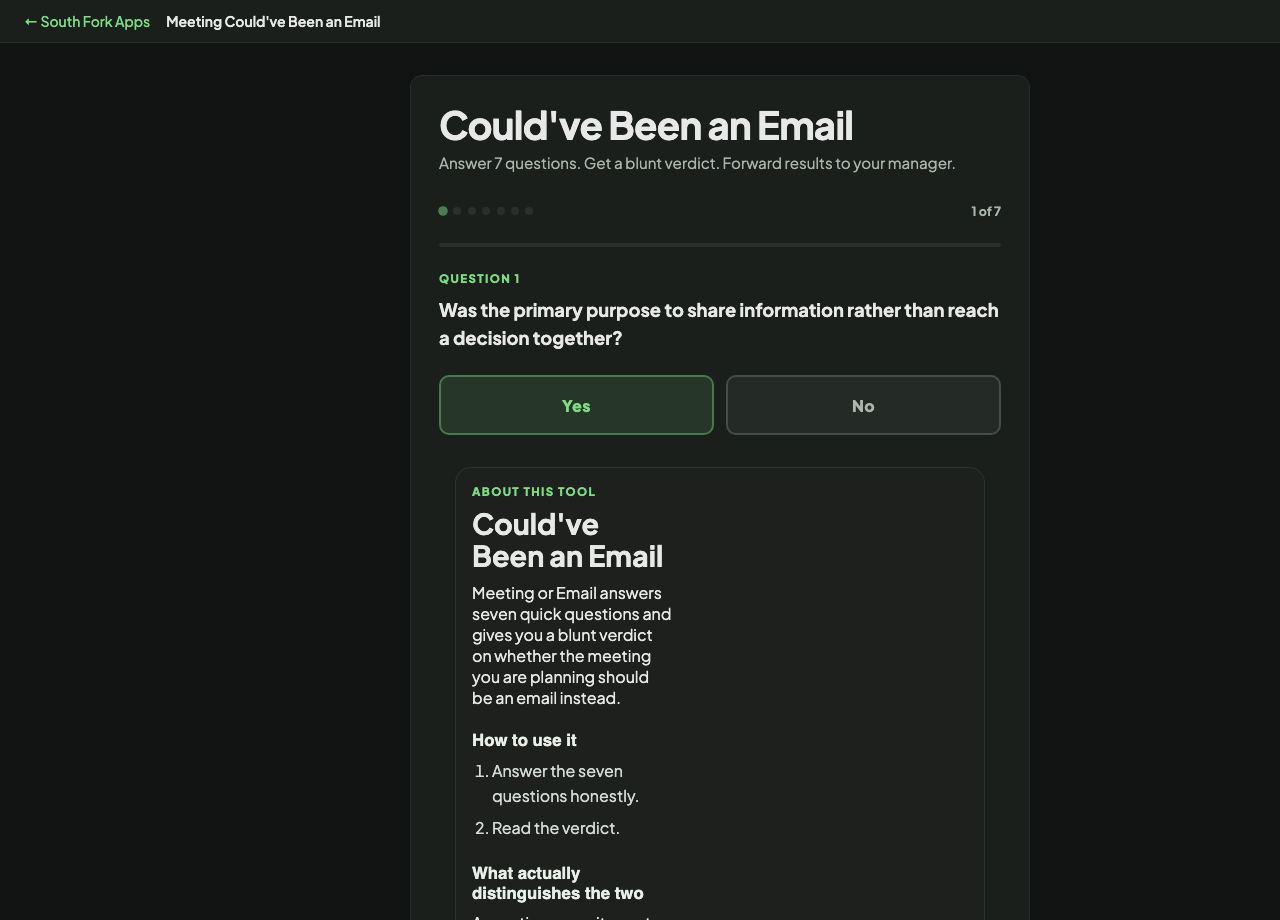
Could've Been an Email
Answer 7 questions. Get a blunt verdict. Forward results to your manager.
1 of 7
About this tool
Could've Been an Email
Meeting or Email answers seven quick questions and gives you a blunt verdict on whether the meeting you are planning should be an email instead.
How to use it
- Answer the seven questions honestly.
- Read the verdict.
What actually distinguishes the two
A meeting earns its cost when it needs real-time back and forth: a decision with genuine disagreement, a problem nobody has solved yet, or a conversation where tone matters. Those are hard to do asynchronously.
Everything else is a broadcast. Status updates, information sharing, and decisions already made are all faster and better as written text, because readers can consume them at their own speed, skip what does not apply, and refer back later. The honest test is whether anyone will say something that changes an outcome.
When it helps
- Checking your own instinct before sending an invitation.
- Giving yourself a defensible reason to cancel something recurring.
- Deciding what a meeting is actually for before scheduling it.
- Reducing a team's meeting load with a consistent rule.
Common mistakes
- Answering as you wish things were rather than as they are.
- Assuming every recurring meeting has earned its place. Recurring meetings are the ones least often re-examined.
- Turning genuinely difficult conversations into email. Anything with conflict or emotional weight goes badly in writing.