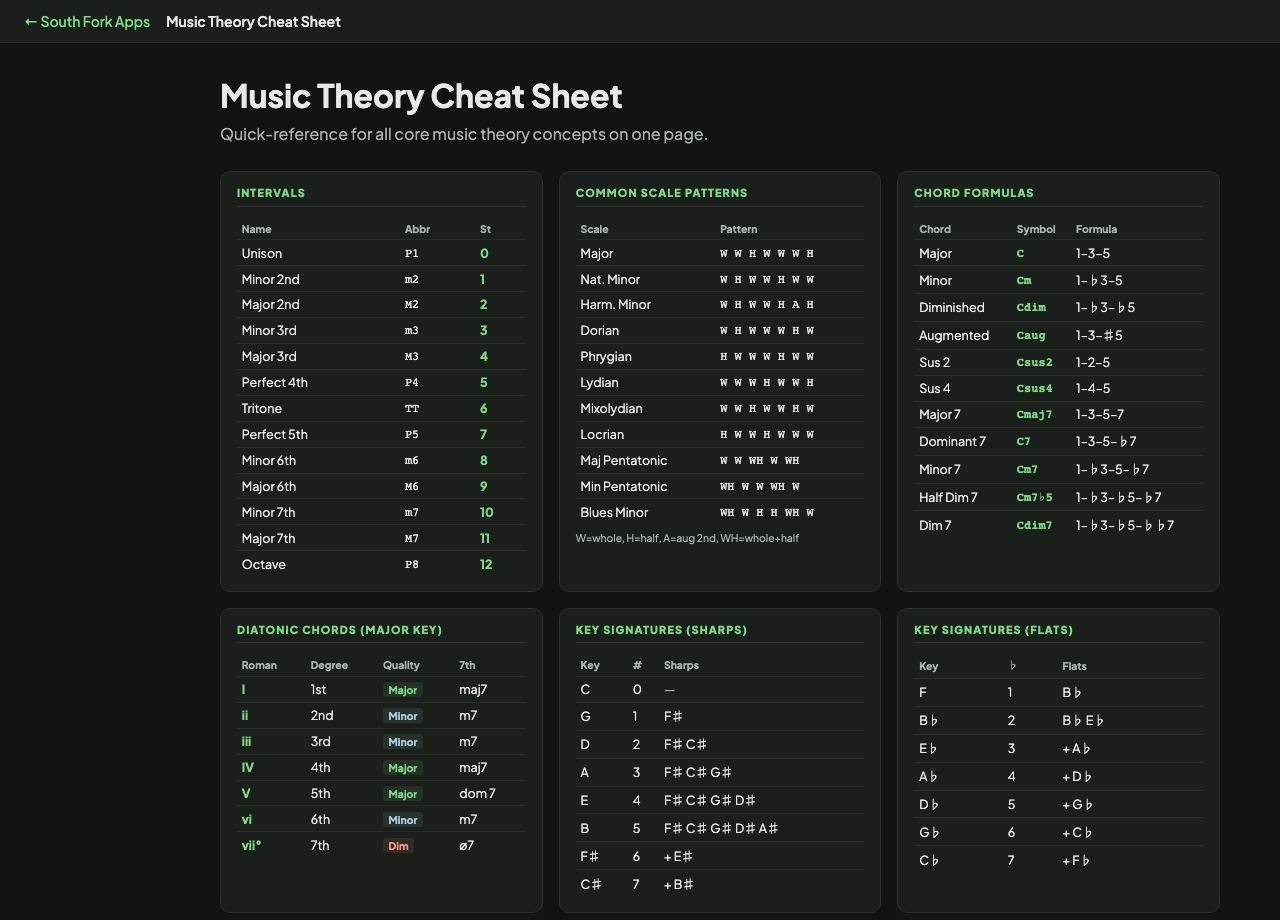
Music Theory Cheat Sheet
Quick-reference for all core music theory concepts on one page.
| Name | Abbr | St |
|---|---|---|
| Unison | P1 | 0 |
| Minor 2nd | m2 | 1 |
| Major 2nd | M2 | 2 |
| Minor 3rd | m3 | 3 |
| Major 3rd | M3 | 4 |
| Perfect 4th | P4 | 5 |
| Tritone | TT | 6 |
| Perfect 5th | P5 | 7 |
| Minor 6th | m6 | 8 |
| Major 6th | M6 | 9 |
| Minor 7th | m7 | 10 |
| Major 7th | M7 | 11 |
| Octave | P8 | 12 |
| Scale | Pattern |
|---|---|
| Major | W W H W W W H |
| Nat. Minor | W H W W H W W |
| Harm. Minor | W H W W H A H |
| Dorian | W H W W W H W |
| Phrygian | H W W W H W W |
| Lydian | W W W H W W H |
| Mixolydian | W W H W W H W |
| Locrian | H W W H W W W |
| Maj Pentatonic | W W WH W WH |
| Min Pentatonic | WH W W WH W |
| Blues Minor | WH W H H WH W |
| Chord | Symbol | Formula |
|---|---|---|
| Major | C | 1–3–5 |
| Minor | Cm | 1–♭3–5 |
| Diminished | Cdim | 1–♭3–♭5 |
| Augmented | Caug | 1–3–♯5 |
| Sus 2 | Csus2 | 1–2–5 |
| Sus 4 | Csus4 | 1–4–5 |
| Major 7 | Cmaj7 | 1–3–5–7 |
| Dominant 7 | C7 | 1–3–5–♭7 |
| Minor 7 | Cm7 | 1–♭3–5–♭7 |
| Half Dim 7 | Cm7♭5 | 1–♭3–♭5–♭7 |
| Dim 7 | Cdim7 | 1–♭3–♭5–♭♭7 |
| Roman | Degree | Quality | 7th |
|---|---|---|---|
| I | 1st | Major | maj7 |
| ii | 2nd | Minor | m7 |
| iii | 3rd | Minor | m7 |
| IV | 4th | Major | maj7 |
| V | 5th | Major | dom 7 |
| vi | 6th | Minor | m7 |
| vii° | 7th | Dim | ø7 |
| Key | # | Sharps |
|---|---|---|
| C | 0 | — |
| G | 1 | F♯ |
| D | 2 | F♯ C♯ |
| A | 3 | F♯ C♯ G♯ |
| E | 4 | F♯ C♯ G♯ D♯ |
| B | 5 | F♯ C♯ G♯ D♯ A♯ |
| F♯ | 6 | + E♯ |
| C♯ | 7 | + B♯ |
| Key | ♭ | Flats |
|---|---|---|
| F | 1 | B♭ |
| B♭ | 2 | B♭ E♭ |
| E♭ | 3 | + A♭ |
| A♭ | 4 | + D♭ |
| D♭ | 5 | + G♭ |
| G♭ | 6 | + C♭ |
| C♭ | 7 | + F♭ |
| Mode | Starts on | Pattern (vs Major) | Character | Example Key |
|---|---|---|---|---|
| Ionian | 1st | Same as Major | Bright, happy | C D E F G A B |
| Dorian | 2nd | ♭3 ♭7 | Jazzy, soulful | D E F G A B C |
| Phrygian | 3rd | ♭2 ♭3 ♭6 ♭7 | Dark, Spanish | E F G A B C D |
| Lydian | 4th | ♯4 | Bright, ethereal | F G A B C D E |
| Mixolydian | 5th | ♭7 | Bluesy, country | G A B C D E F |
| Aeolian | 6th | ♭3 ♭6 ♭7 | Melancholic, minor | A B C D E F G |
| Locrian | 7th | ♭2 ♭3 ♭5 ♭6 ♭7 | Unstable, dissonant | B C D E F G A |
| Name | Numerals |
|---|---|
| 4 Chords | I – V – vi – IV |
| Blues | I – IV – V |
| 50s | I – vi – IV – V |
| Pachelbel | I – V – vi – iii – IV |
| Jazz ii-V-I | ii – V – I |
| Andalusian | i – VII – VI – V |
| Minor vamp | i – VII – VI – VII |
| Note | Beats | Symbol |
|---|---|---|
| Whole | 4 | 𝅝 |
| Half | 2 | 𝅗𝅥 |
| Quarter | 1 | ♩ |
| Eighth | ½ | ♪ |
| Sixteenth | ¼ | 𝅘𝅥𝅯 |
| Dotted ♩ | 1.5 | ♩. |
| Triplet | ⅔ | 3:2 |
| Interval | Song Reference |
|---|---|
| m2 | Jaws theme |
| M2 | Happy Birthday |
| m3 | Smoke on the Water |
| M3 | When the Saints Go Marching |
| P4 | Here Comes the Bride |
| TT | The Simpsons theme |
| P5 | Star Wars theme |
| m6 | The Entertainer |
| M6 | My Bonnie Lies Over the Ocean |
| m7 | Somewhere (West Side Story) |
| M7 | Take On Me |
| P8 | Somewhere Over the Rainbow |
Music Theory Cheat Sheet
Music Theory Cheat Sheet collects the reference material you keep looking up: intervals, scale formulas, chord construction, the circle of fifths, key signatures and common progressions, all on one page.
How the pieces connect
Almost all of Western theory follows from two ideas. First, the octave is divided into twelve equal semitones. Second, a major scale picks seven of them using the pattern whole, whole, half, whole, whole, whole, half.
Everything else is built on that. Chords are alternate notes from a scale stacked up. Keys are scales given a home note. The circle of fifths is what you get when you order the twelve keys by how many notes they share, which is why keys next to each other on it sound related.
When it helps
- Checking a formula mid-practice without hunting through a textbook.
- Revising before a theory exam or an audition.
- Settling an argument about what a chord symbol means.
- Teaching, where having every reference on one page saves time.
What this tool handles
- Covers intervals, scales and modes, chord construction, key signatures, the circle of fifths and common progressions.
- Written as reference material rather than a course, so it assumes you want the answer rather than the lesson.