Note Identification
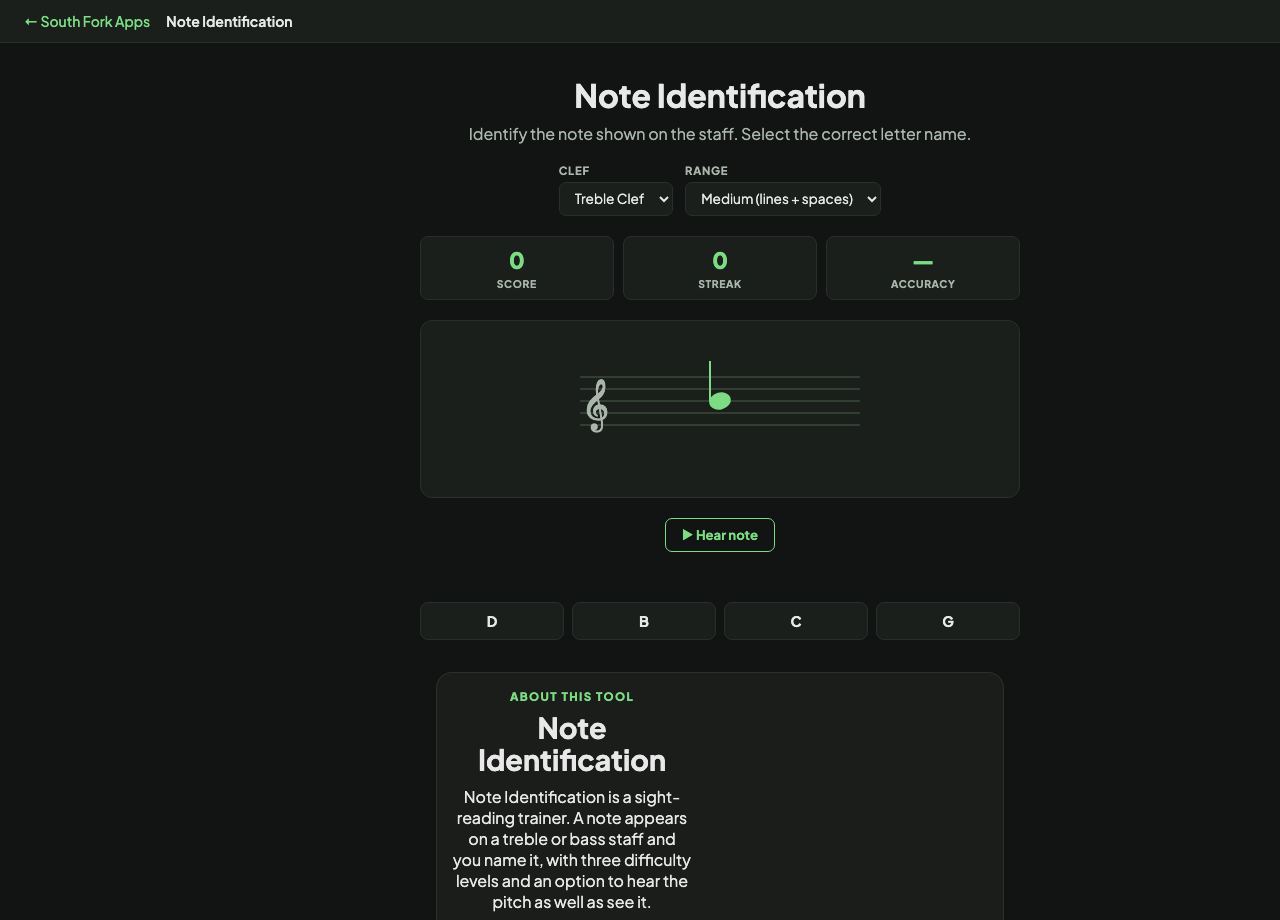
Identify the note shown on the staff. Select the correct letter name.
0
Score
0
Streak
—
Accuracy
About this tool
Note Identification
Note Identification is a sight-reading trainer. A note appears on a treble or bass staff and you name it, with three difficulty levels and an option to hear the pitch as well as see it.
How to use it
- Choose treble or bass clef.
- Pick a range: Easy for lines only, Medium for lines and spaces, Hard to include ledger lines.
- Name the note shown, and use Hear note to connect the symbol to the sound.
The mnemonics, and what to do after them
Treble clef lines from the bottom are E, G, B, D, F, and the spaces spell FACE. Bass clef lines are G, B, D, F, A and the spaces are A, C, E, G.
Mnemonics get you started but they are slow, because reciting a sentence takes longer than reading a word. Fluent readers recognise landmark notes on sight (the G that the treble clef curls around, the F between the bass clef dots) and count a step or two from there.
When it helps
- Building sight-reading speed with short, frequent practice.
- Learning the second clef when you already read one fluently.
- Getting comfortable with ledger lines, which is where most readers stall.
- Connecting written pitch to actual sound through the playback option.
Common mistakes
- Practising only treble clef. The bass clef is not harder, it is just less practised.
- Skipping ledger lines because they are uncomfortable. That discomfort is the reason to practise them.
- Long rare sessions instead of short daily ones. Sight-reading responds to frequency more than duration.