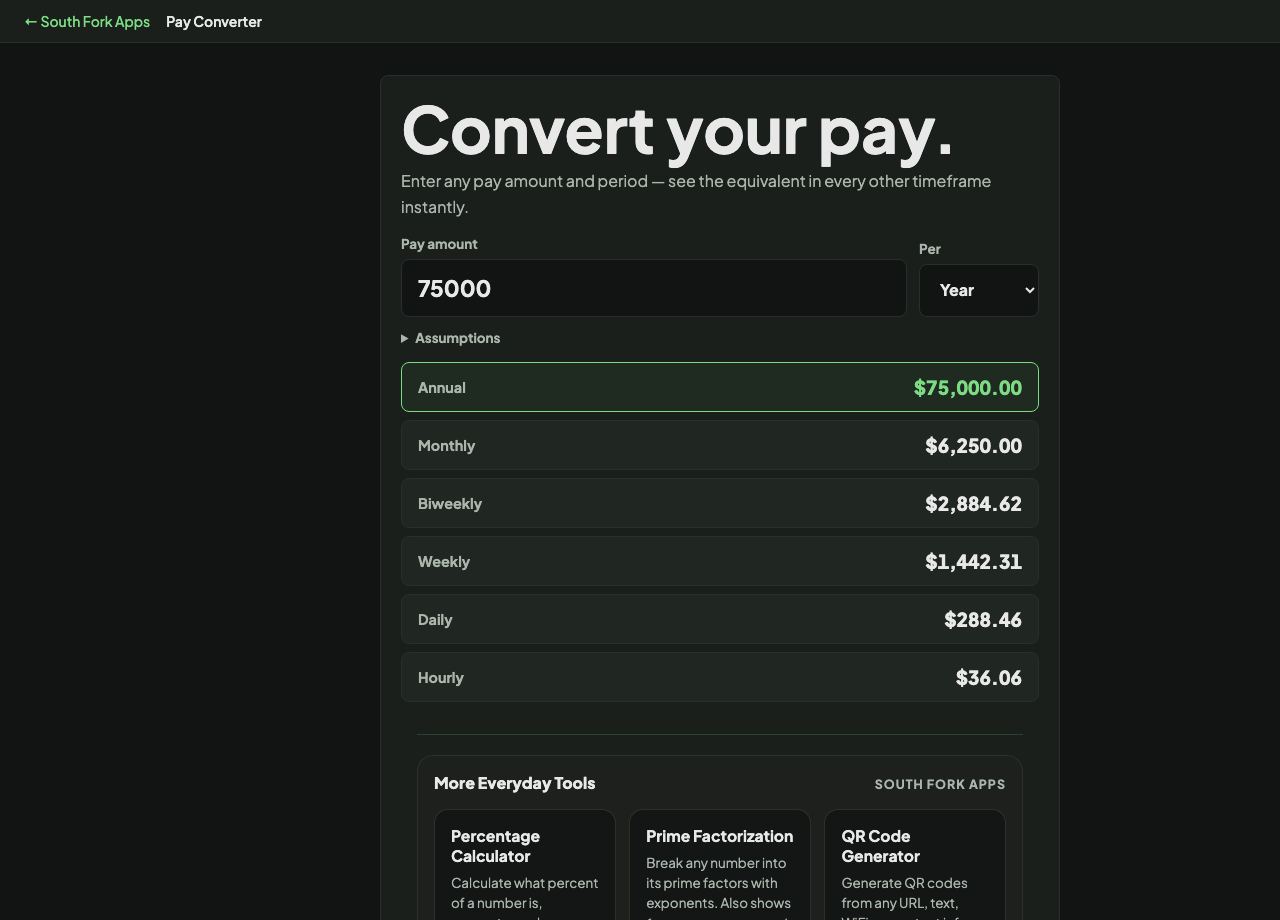
Pay Converter
Enter any pay amount and period — see the equivalent in every other timeframe instantly.
Assumptions
Pay Converter
Pay Converter translates a salary between hourly, daily, weekly, biweekly, monthly and annual figures, using your own hours per day and days per week.
How to use it
- Enter the pay amount and select what period it covers.
- Set your hours per day and days per week.
- Read the equivalent at every other period.
Where the standard numbers come from
The usual full-time assumption is 8 hours a day, 5 days a week, 52 weeks a year, which gives 2,080 working hours. Dividing an annual salary by 2,080 is the standard way to reach an hourly equivalent.
That assumption ignores paid leave. If your salary includes three weeks off, you actually work about 1,960 hours for it, so your true hourly rate is higher than the 2,080 figure suggests. The gap matters when comparing a salaried role to contract work with no paid leave.
Worked example
The default salary at standard hours:
- Annual$75,000
- Hours8 per day, 5 days per week
- Working hoursabout 2,080 per year
Result: Roughly $36 an hour, or about $6,250 a month.
When it helps
- Comparing a salaried offer against an hourly or contract rate.
- Working out what a raise is worth per hour.
- Converting a job listing's figure into the period you think in.
- Budgeting from an annual figure to a monthly one.
Common mistakes
- Comparing a salary to a contract rate without adjusting for benefits, paid leave, and self-employment tax. A contract rate needs to be substantially higher to be equivalent.
- Dividing an annual salary by 12 and calling it monthly take-home. That is gross, before tax and deductions.
- Forgetting biweekly means 26 payments a year, not 24.