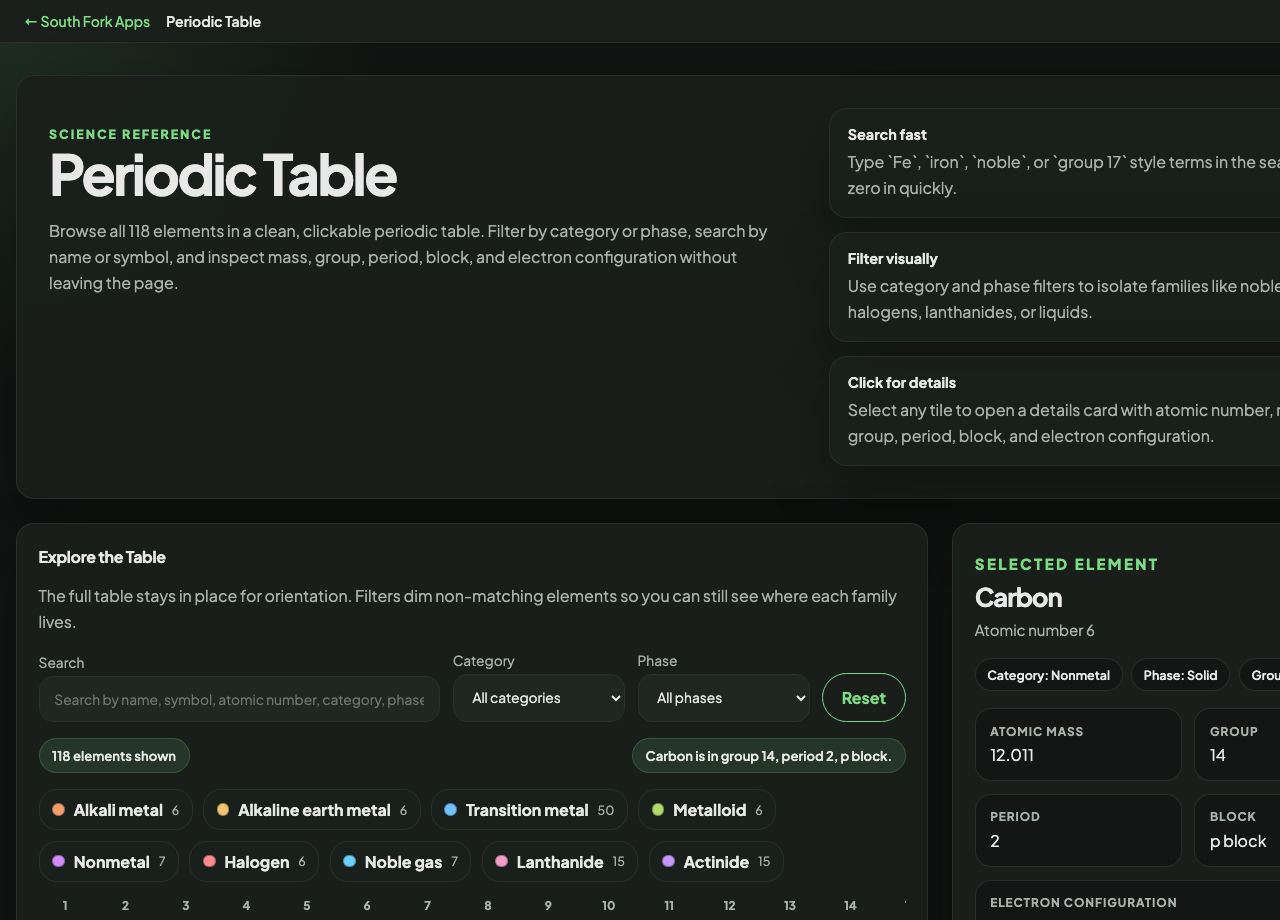
Science Reference
Periodic Table
Browse all 118 elements in a clean, clickable periodic table. Filter by category or phase, search by name or symbol, and inspect mass, group, period, block, and electron configuration without leaving the page.
Explore the Table
The full table stays in place for orientation. Filters dim non-matching elements so you can still see where each family lives.
About this tool
Periodic Table
Periodic Table is a clickable reference to all 118 elements with atomic mass, group, period, category and phase, with search and filtering.
How to use it
- Click any element for its details.
- Filter by category or phase.
- Search by name or symbol.
Why the shape is the information
Elements are ordered by atomic number, the count of protons, and arranged so that elements in the same column share the same number of outer electrons. That is why a column behaves alike: group 1 metals all react vigorously with water, and group 18 noble gases barely react at all.
The rows are periods, and each one corresponds to an electron shell being filled. The table's odd shape, with the lanthanides and actinides pulled out below, is a consequence of the order in which electron subshells fill rather than an arbitrary layout choice.
When it helps
- Looking up an element's mass, symbol or category.
- Understanding why elements in a column behave similarly.
- Revising chemistry with a searchable reference.
- Checking a phase or a category quickly.
Common mistakes
- Reading atomic mass as a whole number. It is a weighted average across isotopes, which is why chlorine is about 35.45.
- Confusing atomic number with mass number. The first is protons, the second protons plus neutrons.
- Assuming the heaviest elements exist in any usable quantity. Many are synthesised in atom-scale amounts and decay in moments.