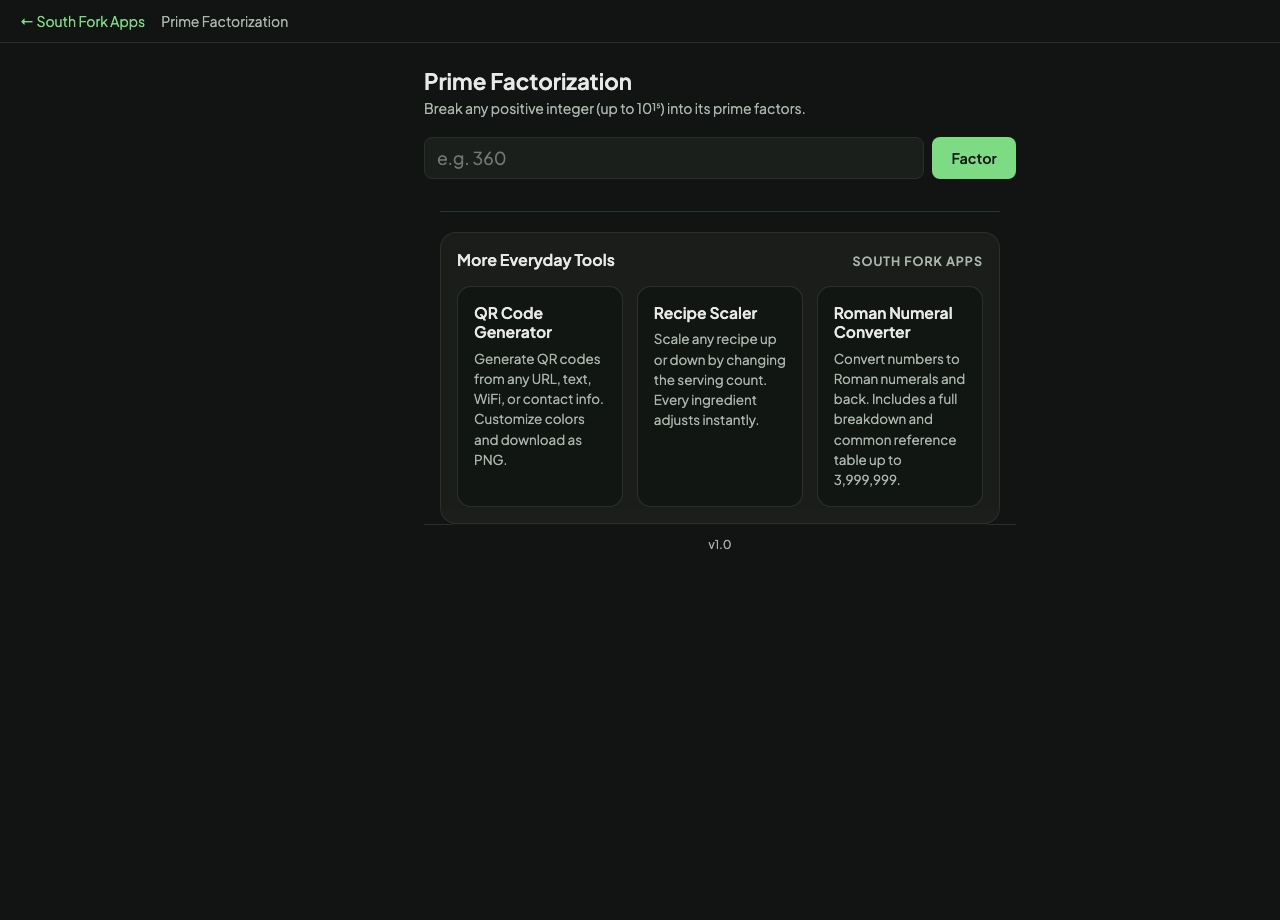
Prime Factorization
Break any positive integer (up to 10¹⁵) into its prime factors.
Prime Factorization
Prime Factorization breaks any number into its prime factors, showing exponents and the full factor tree.
How to use it
- Enter a number.
- Read its prime factors with exponents.
Why the answer is always unique
The fundamental theorem of arithmetic states that every integer greater than one has exactly one prime factorisation, ignoring the order of the factors. There is no number with two different sets of prime factors, which is what makes factorisation a definitive answer rather than one of several.
Finding those factors is easy for small numbers and extremely hard for very large ones. That asymmetry is the foundation of RSA encryption: multiplying two large primes is trivial, and recovering them from the product is not.
Worked example
Factorising 360:
- Divide by 2180, 90, 45
- Divide by 315, 5
- Remaining5
Result: 2^3 x 3^2 x 5, and no other combination of primes produces 360.
When it helps
- Simplifying fractions by finding shared factors.
- Finding a greatest common divisor or least common multiple.
- Checking whether a number is prime.
- Working through number theory problems.
Common mistakes
- Including 1 as a prime factor. One is not prime, by definition, precisely so that factorisation stays unique.
- Stopping too early. Keep dividing until every remaining factor is prime.
- Expecting instant results for very large numbers. The difficulty is the entire basis of modern cryptography.