← South Fork Apps

Reading Level Analyzer

Paste Your Text
Results

Paste text on the left to see readability analysis.

About this tool

Reading Level Analyzer

Reading Level Analyzer scores text with the Flesch reading ease and Flesch-Kincaid grade level formulas, giving you a US school grade estimate for how demanding a piece is.

The formulas, and what they actually measure

Flesch reading ease is 206.835 minus 1.015 times the average words per sentence, minus 84.6 times the average syllables per word. Higher is easier. Flesch-Kincaid grade level rearranges the same two inputs to output a US grade instead.

Both formulas only see two things: how long your sentences are and how many syllables your words have. They know nothing about logic, structure or whether a sentence makes sense. A well-argued paragraph and a grammatically identical piece of nonsense score the same.

Worked example

How the scale reads:

  • 90 to 100very easy, around 5th grade
  • 60 to 70plain English, 8th to 9th grade
  • 30 to 50difficult, college level
  • Below 30very difficult, graduate level

Result: General audience writing usually targets 60 to 70, the range most newspapers sit in.
When it helps

  • Checking that public-facing writing is accessible.
  • Meeting a plain-language requirement for a policy or a form.
  • Comparing a draft against published writing you consider clear.
  • Spotting sections where sentence length has crept up.

Common mistakes

  • Chasing a lower grade by chopping every sentence short. That produces choppy writing that scores well and reads badly.
  • Applying the formulas to technical documents. Necessary domain terms are long and the score punishes them unfairly.
  • Treating the grade as a verdict on quality. It measures surface complexity only.
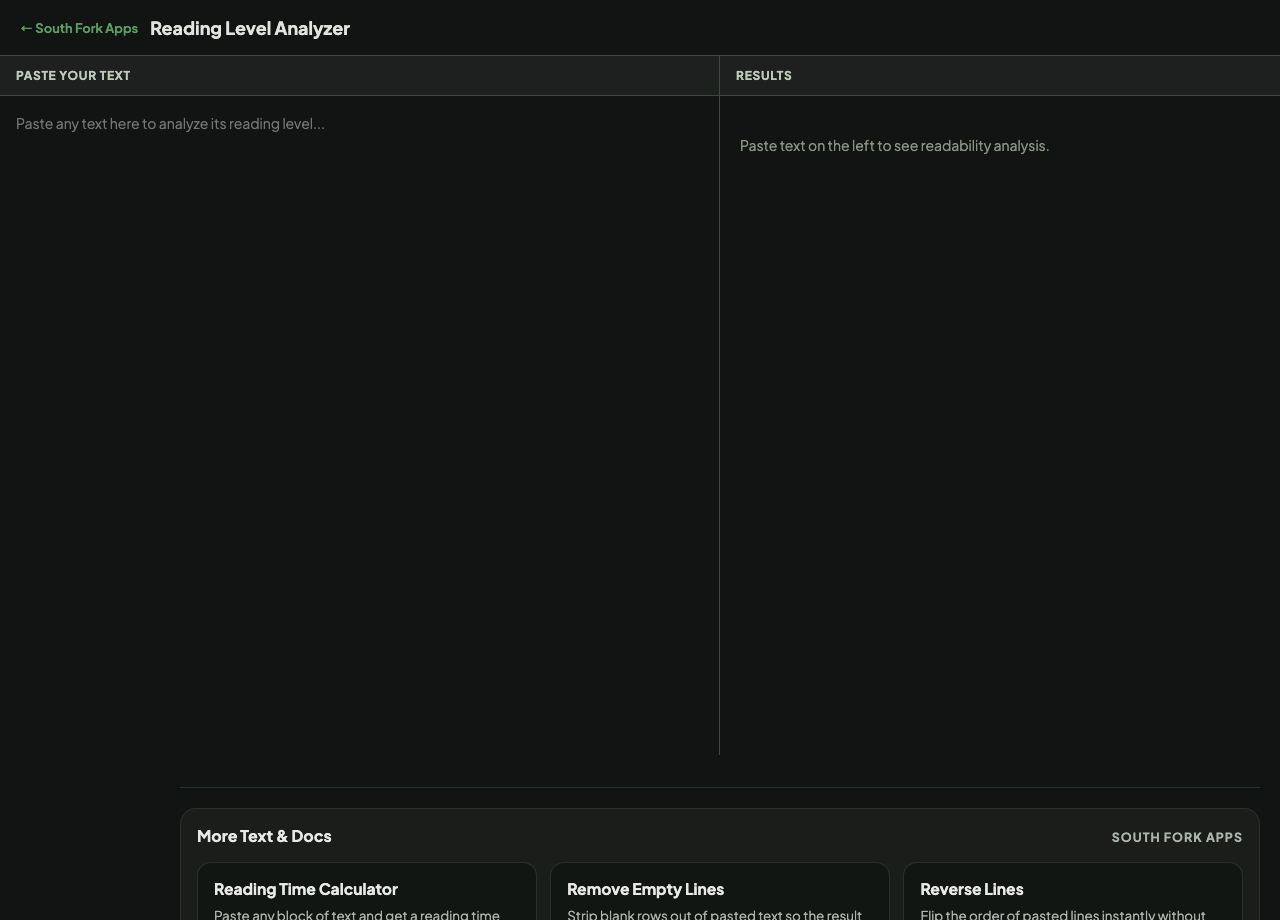
Reading Level Analyzer interface preview
Screenshot of the live Reading Level Analyzer interface.

v1.0