About this tool
Resistor Color Code
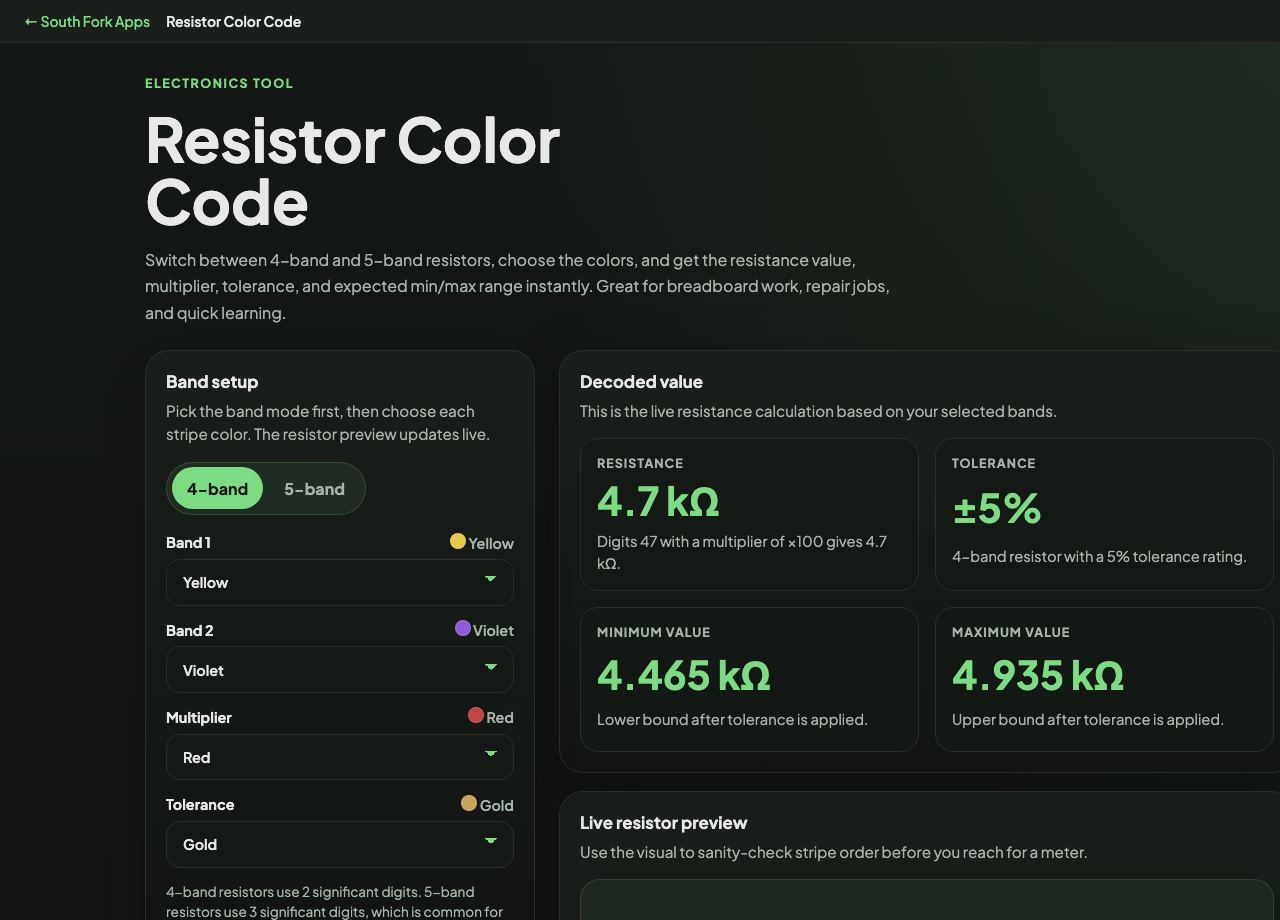
Resistor Color Code decodes 4-band and 5-band resistors into a resistance value, or builds the band colours from a value you specify, with tolerance.
How to use it
- Select the number of bands.
- Set each band's colour to match your resistor.
- Read the resistance and tolerance, or work backwards from a value.
Reading the bands
The colours encode digits: black 0, brown 1, red 2, orange 3, yellow 4, green 5, blue 6, violet 7, grey 8, white 9. On a 4-band resistor the first two bands are digits, the third is the multiplier as a power of ten, and the fourth is tolerance. A 5-band adds a third digit for greater precision.
Tolerance has its own colours: gold is 5%, silver 10%, brown 1%, red 2%. The tolerance band is usually gold or silver and slightly separated from the others, which is how you know which end to read from.
Worked example
A common 4-band resistor:
- Brown, black, red1, 0, times 100
- Gold5% tolerance
Result: 1,000 ohms, or 1k, anywhere from 950 to 1,050 ohms in practice.
When it helps
- Identifying a resistor from a drawer of unlabelled parts.
- Finding the band colours for a value you need to pick out.
- Checking a resistor before soldering it.
- Learning the code rather than looking it up every time.
Common mistakes
- Reading the bands from the wrong end. Start from the end where the bands are closer together, with tolerance last.
- Confusing red and orange, or brown and red, under poor light. Measuring with a meter settles it.
- Forgetting tolerance. A 5% resistor genuinely varies, which matters in precision circuits.