← South Fork Apps

Roman Numeral Converter

Roman Numeral
—
About this tool

Roman Numeral Converter

Roman Numeral Converter goes both ways between numbers and Roman numerals, handling values from 1 up to 3,999,999.

How to use it

  1. Enter a number to convert to Roman numerals.
  2. Or enter Roman numerals to get the number.
  3. Copy whichever result you need.

The subtractive rule

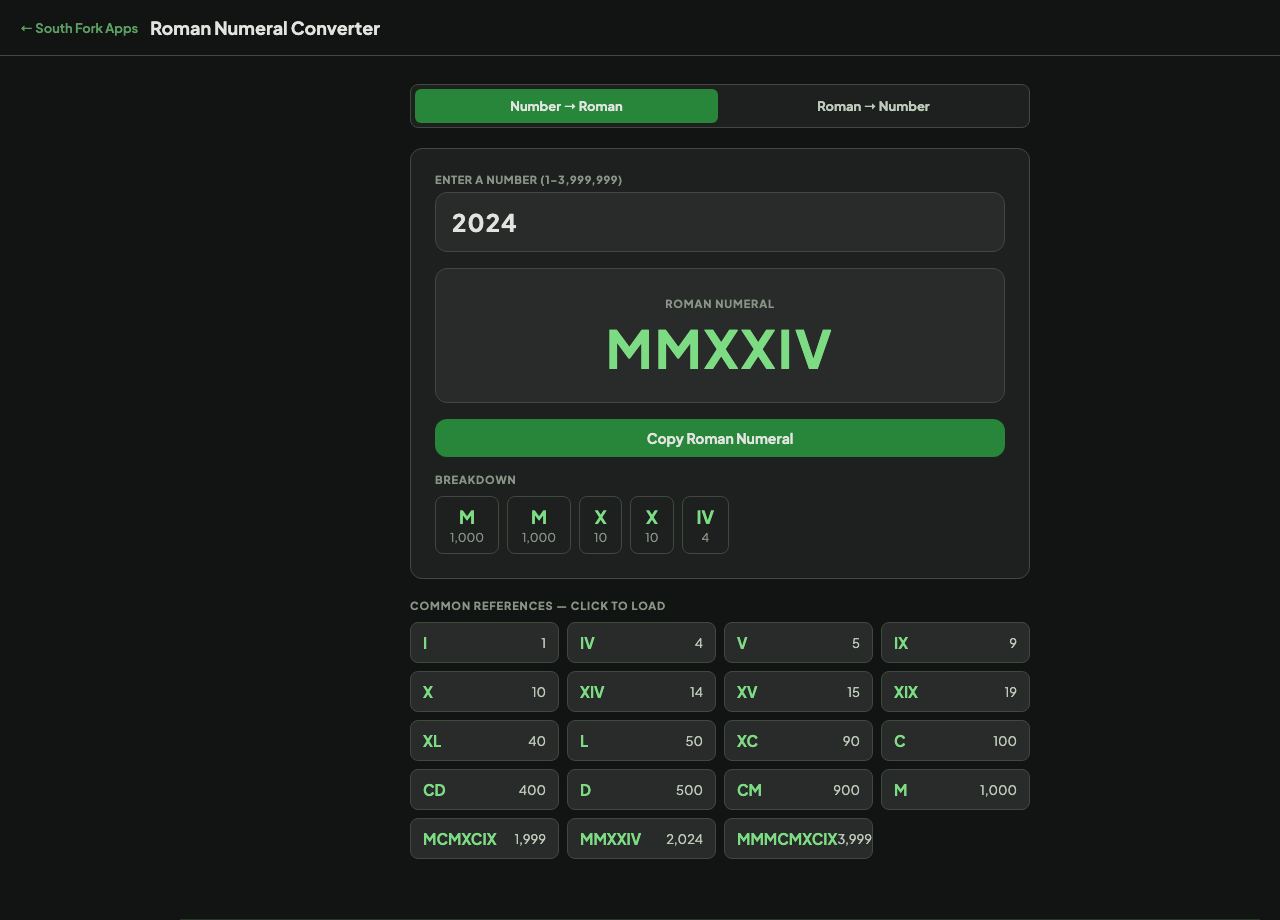
The seven symbols are I=1, V=5, X=10, L=50, C=100, D=500 and M=1000. Ordinarily values are written largest first and added together, so MMXXIV builds up from 1000+1000+10+10+(5-1).

The subtractive rule is the exception: a smaller symbol before a larger one is subtracted, giving IV for 4 and IX for 9 rather than IIII and VIIII. Only six subtractive pairs are valid (IV, IX, XL, XC, CD, CM), which is why IL is not a legal way to write 49. It is XLIX.

Worked example

Reading a year:

  • MMXXIVM+M+X+X+IV
  • Arithmetic1000+1000+10+10+4

Result: 2024. The IV at the end is the subtractive pair, not a mistake.
When it helps

  • Reading a copyright date or a cornerstone inscription.
  • Numbering chapters, appendices or outline sections.
  • Converting a clock face or a monarch's regnal number.
  • Checking a numeral before engraving or printing it.

Common mistakes

  • Inventing subtractive pairs. Only six are valid, so 99 is XCIX and never IC.
  • Repeating a symbol more than three times. IIII appears on some clock faces by convention but is not standard notation.
  • Expecting a zero. Roman numerals have no symbol for zero and no way to express one.
Roman Numeral Converter interface preview
Screenshot of the live Roman Numeral Converter interface.

v1.0