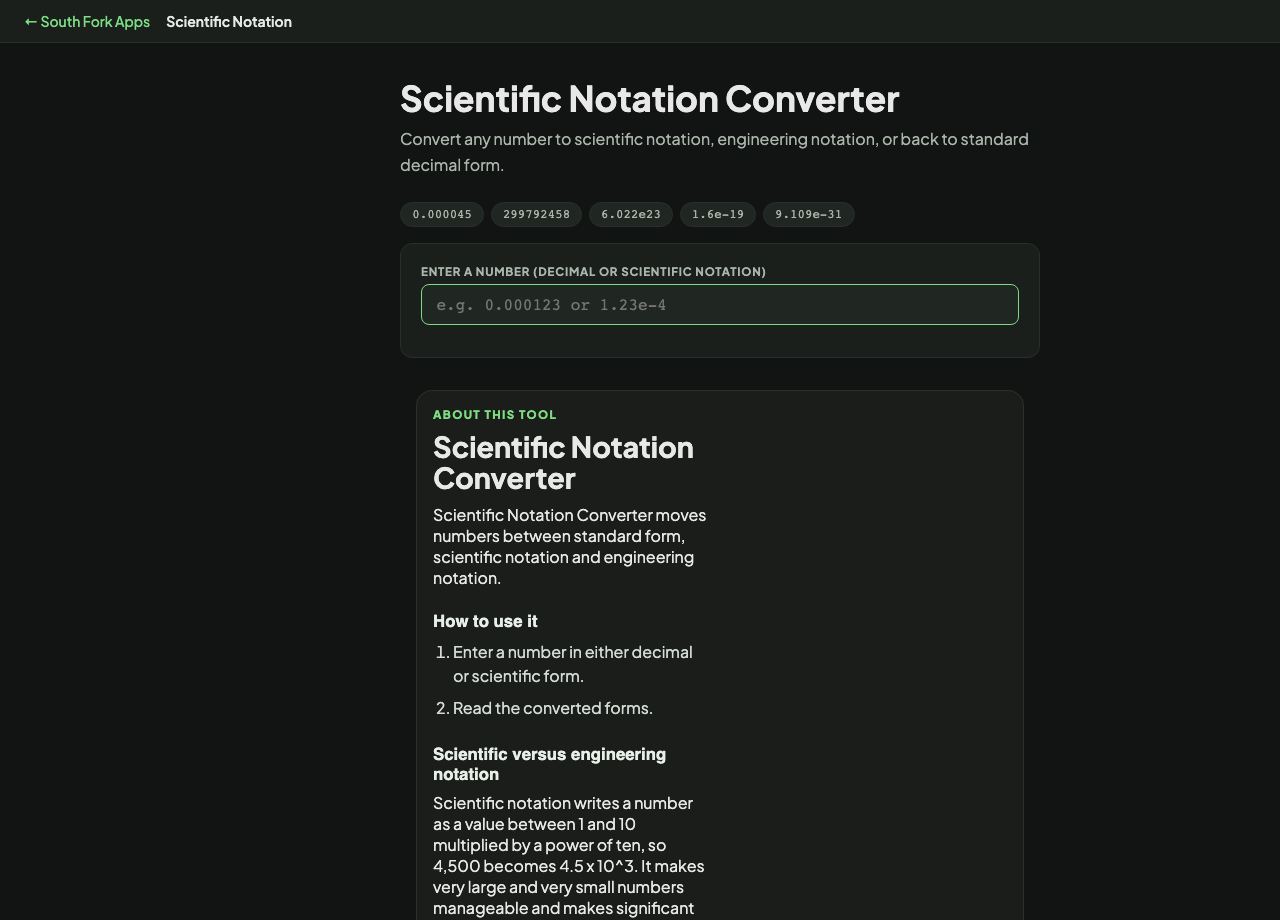
Scientific Notation Converter
Convert any number to scientific notation, engineering notation, or back to standard decimal form.
Scientific Notation Converter
Scientific Notation Converter moves numbers between standard form, scientific notation and engineering notation.
How to use it
- Enter a number in either decimal or scientific form.
- Read the converted forms.
Scientific versus engineering notation
Scientific notation writes a number as a value between 1 and 10 multiplied by a power of ten, so 4,500 becomes 4.5 x 10^3. It makes very large and very small numbers manageable and makes significant figures explicit.
Engineering notation restricts the exponent to multiples of three, so it lines up with the metric prefixes: kilo, mega, giga, milli, micro, nano. That is why an engineer writes 45 x 10^3 rather than 4.5 x 10^4, because it maps directly onto kilo-units.
Worked example
The same value in three forms:
- Standard4,500
- Scientific4.5 x 10^3
- Engineering4.5 x 10^3, read as 4.5 kilo
Result: Both agree here; they diverge whenever the exponent is not already a multiple of three.
When it helps
- Working with very large or very small measurements.
- Converting a value into engineering notation for a datasheet.
- Making significant figures explicit.
- Reading a number given in exponent form.
Common mistakes
- Writing a mantissa outside 1 to 10 and calling it scientific notation.
- Losing track of significant figures. The notation makes them explicit, which is much of the point.
- Confusing the E notation used by calculators and spreadsheets with the exponent itself. 4.5E3 means 4.5 x 10^3.