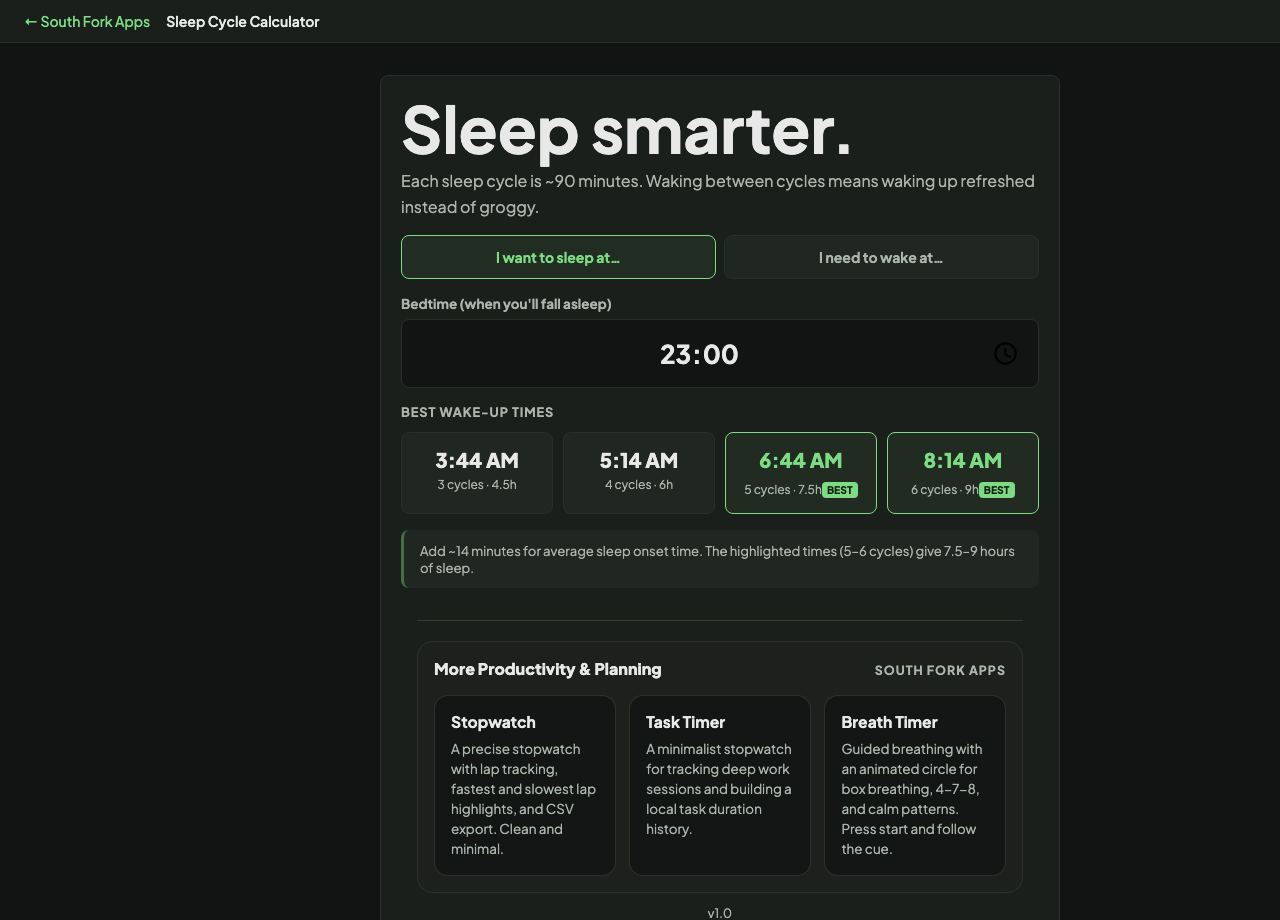
Sleep Cycle Calculator
Each sleep cycle is ~90 minutes. Waking between cycles means waking up refreshed instead of groggy.
Sleep Cycle Calculator
Sleep Cycle Calculator suggests bedtimes or wake times built around 90-minute sleep cycles, so you wake between cycles rather than in the middle of deep sleep.
How to use it
- Enter either when you want to wake up or when you are going to bed.
- Read the suggested times.
- Pick one that gives you five or six complete cycles.
How the times are worked out
A sleep cycle averages about 90 minutes, moving through light sleep, deep sleep and REM. Waking at the end of a cycle, in light sleep, feels far easier than waking mid-cycle, which produces the heavy grogginess of sleep inertia.
The calculation also allows roughly 14 minutes to fall asleep, which is the population average. Five cycles is 7.5 hours and six is 9, which is why those two figures come up so often in sleep advice.
Worked example
Working backwards from a 6:30 am alarm:
- Six cycles (9 hours)asleep by about 9:30 pm
- Five cycles (7.5 hours)asleep by about 11:00 pm
- Plus time to fall asleepabout 14 minutes earlier to bed
Result: Five complete cycles beats six interrupted ones, which is why the timing can matter more than the total.
When it helps
- Choosing a bedtime that fits the alarm you cannot move.
- Deciding between two possible wake times.
- Planning a short night so it is as restorative as possible.
- Understanding why eight hours sometimes feels worse than seven and a half.
Common mistakes
- Treating 90 minutes as exact. Cycle length varies between people and across the night, so the times are approximate.
- Using cycle timing to justify chronic short sleep. Five well-timed cycles is not equivalent to enough sleep.
- Ignoring consistency. A regular schedule matters more than optimising any single night.
What this tool handles
- General information, not medical advice. Persistent sleep problems are worth discussing with a doctor.