Solfege
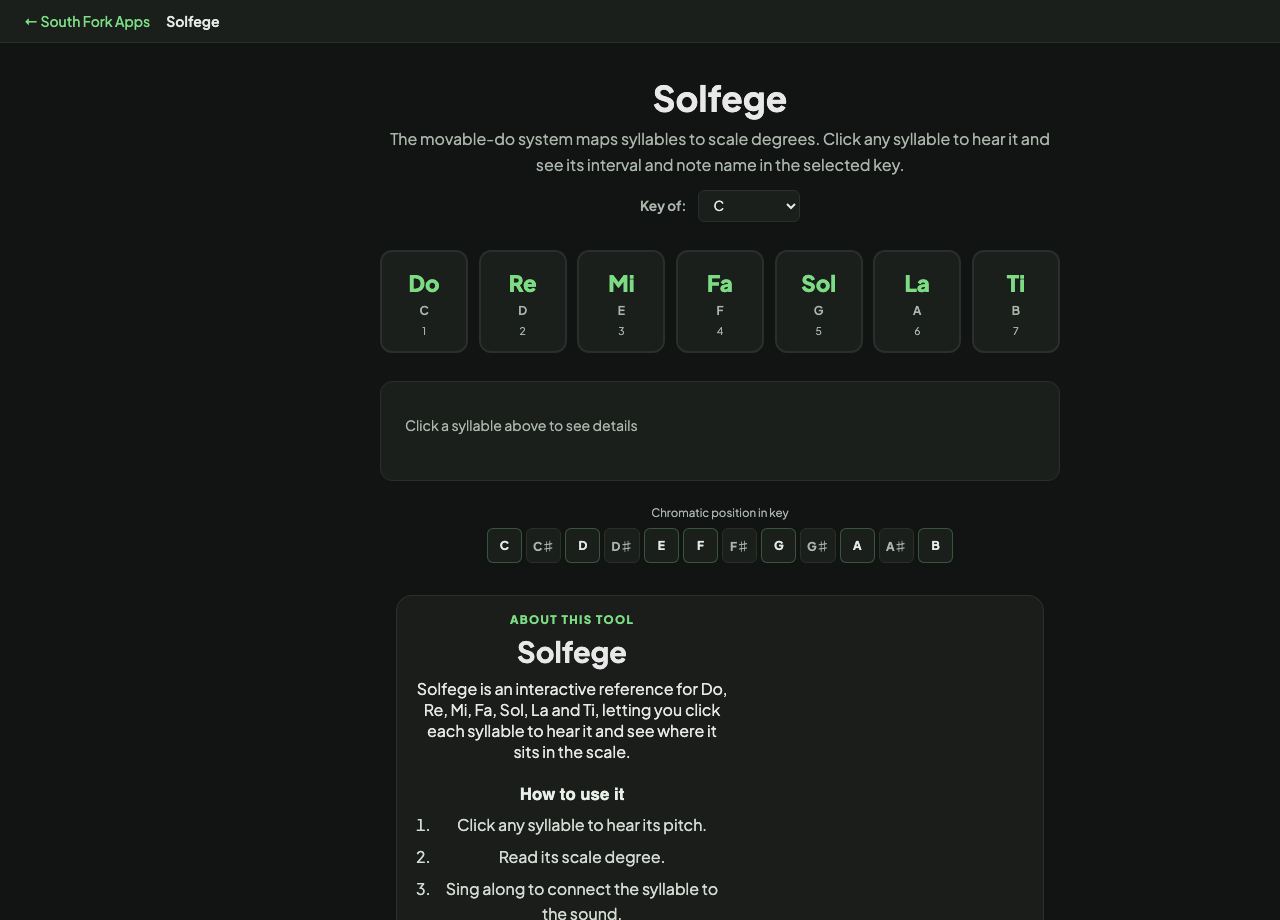
The movable-do system maps syllables to scale degrees. Click any syllable to hear it and see its interval and note name in the selected key.
Click a syllable above to see details
Solfege
Solfege is an interactive reference for Do, Re, Mi, Fa, Sol, La and Ti, letting you click each syllable to hear it and see where it sits in the scale.
How to use it
- Click any syllable to hear its pitch.
- Read its scale degree.
- Sing along to connect the syllable to the sound.
Movable do and fixed do
In movable do, used across the English-speaking world, Do is always the tonic of whatever key you are in. Every key sounds the same in solfege, which trains the relationships rather than the pitches, and is why it works so well for sight-singing.
In fixed do, used in France, Italy and much of Latin America, Do is always the note C regardless of key. It is effectively a set of note names. Both systems are valid and they are not compatible, which causes real confusion when musicians trained in different traditions try to work together.
When it helps
- Learning to sight-sing.
- Internalising scale degrees so you hear function rather than pitch.
- Teaching pitch relationships to beginners.
- Transposing by ear, which movable do makes almost automatic.
Common mistakes
- Mixing the two systems, which produces contradictory answers for the same note.
- Learning the syllables as labels without singing them. The point is the sound, not the vocabulary.
- Skipping chromatic syllables. Di, Ri, Fi and their flat counterparts exist and are needed for anything beyond the plain major scale.