Time Signatures
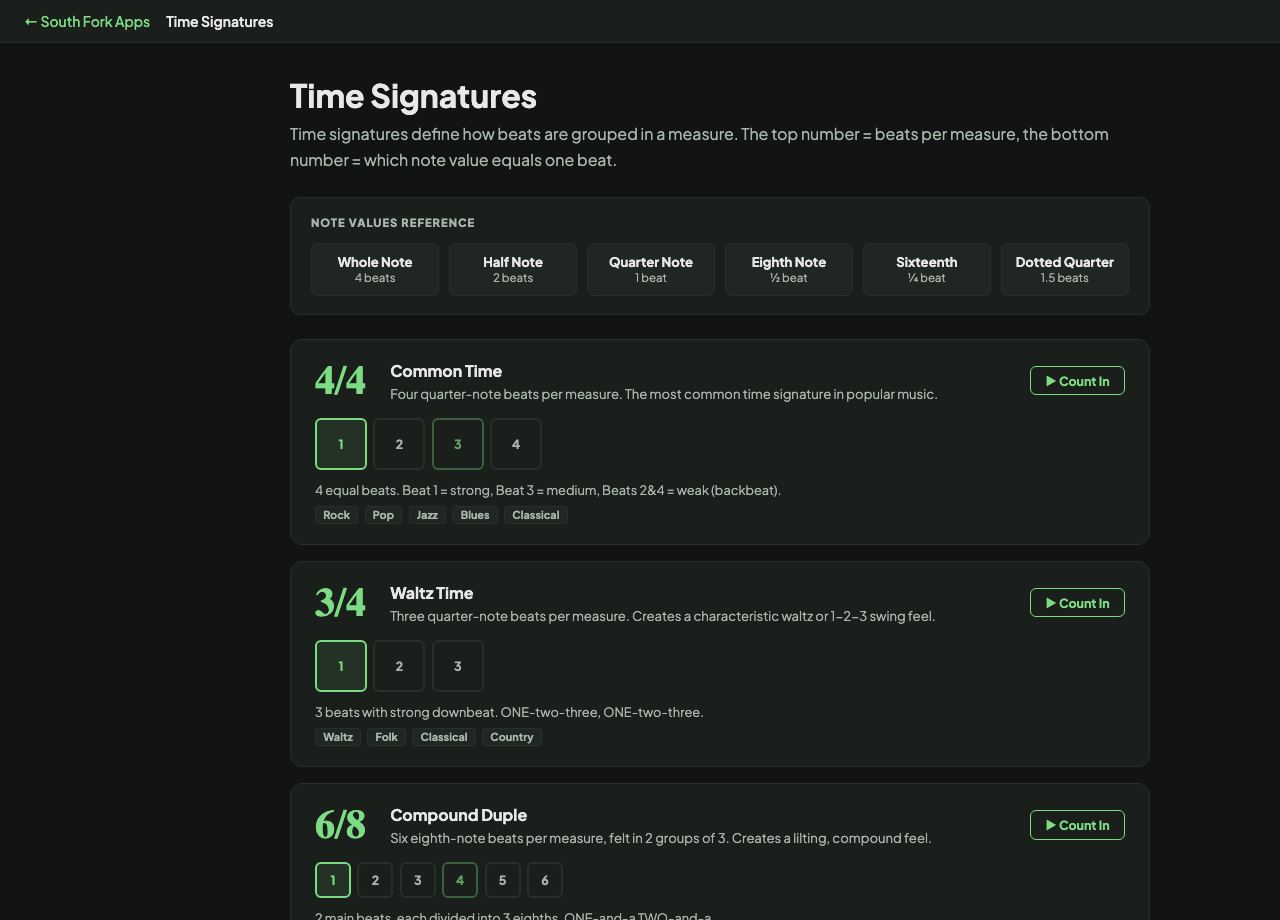
Time signatures define how beats are grouped in a measure. The top number = beats per measure, the bottom number = which note value equals one beat.
Time Signatures
Time Signatures is a reference covering the common signatures with their beat groupings, how each one feels, and how to count them.
Reading the two numbers
The top number is how many beats are in a bar. The bottom number says which note value counts as one beat: 4 means a quarter note, 8 means an eighth. So 3/4 is three quarter notes and 6/8 is six eighth notes.
The important distinction is simple versus compound. In simple meters like 4/4 and 3/4, each beat divides into two. In compound meters like 6/8 and 9/8, each beat divides into three, so 6/8 is really two beats of three rather than six beats of one. That grouping is what makes 6/8 lilt while 3/4 waltzes, even though both contain six eighth notes.
Worked example
Two signatures with the same total length:
- 3/4three beats, each divided in two
- 6/8two beats, each divided in three
Result: Six eighth notes either way, grouped completely differently, which is why they feel nothing alike.
When it helps
- Working out how to count an unfamiliar piece.
- Understanding why a piece feels the way it does.
- Learning odd meters like 5/4 and 7/8 and how they subdivide.
- Choosing a time signature when writing.
Common mistakes
- Counting 6/8 as six equal beats. It is two groups of three, and counting it flat destroys the feel.
- Assuming the top number alone determines the feel. Grouping matters as much.
- Thinking common time is a C for common. It is a broken circle, left over from medieval notation where a full circle meant triple time.