About this tool
Token Usage Calculator
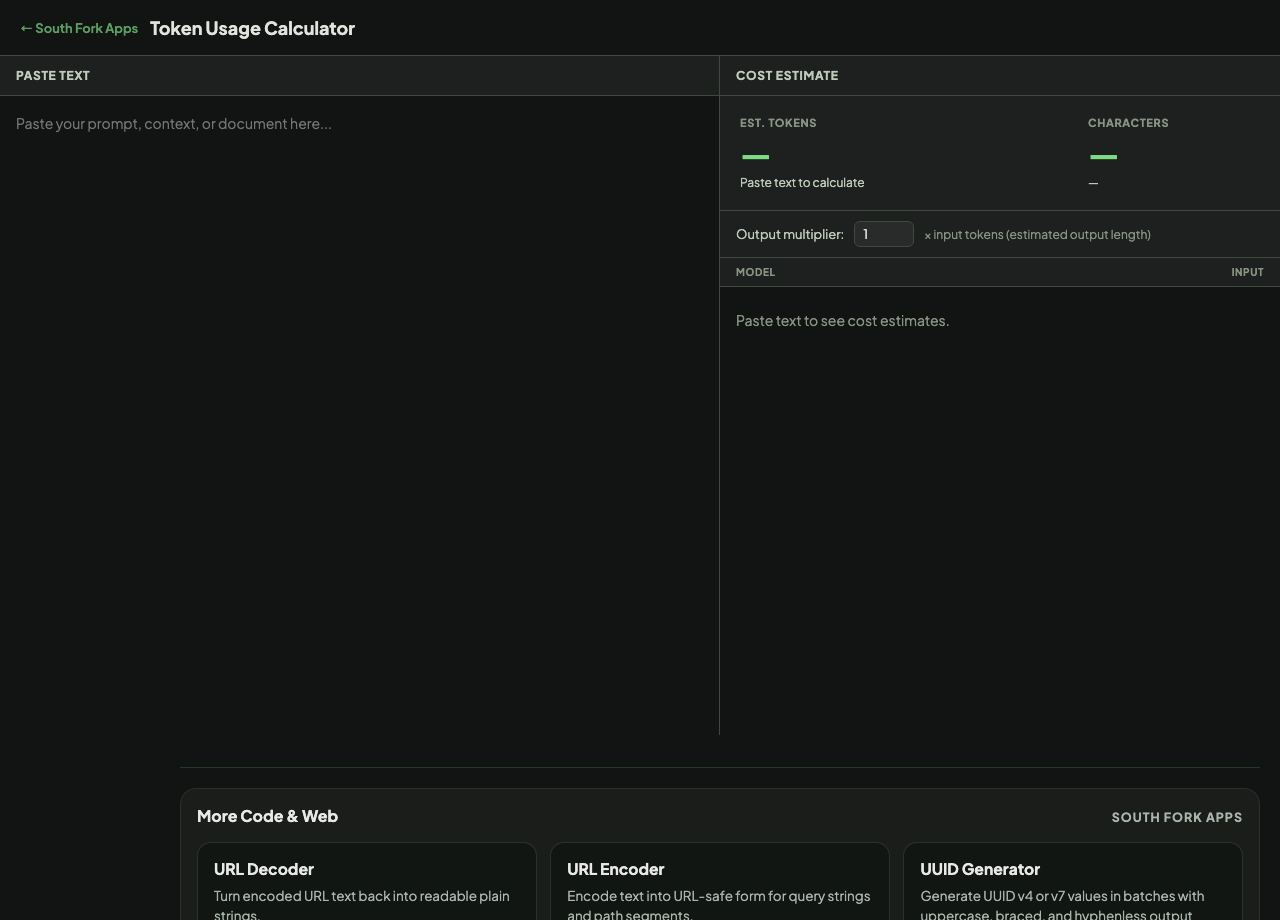
Token Usage Calculator estimates how many tokens a piece of text uses and what it would cost across common large language model APIs, with an output multiplier for estimating a full request and response.
How to use it
- Paste your prompt text.
- Set the output multiplier to estimate the response length relative to the input.
- Read the estimated token count and cost per model.
What a token is, roughly
Models do not read characters or words, they read tokens, which are frequent character sequences. For ordinary English, a useful rule of thumb is about four characters per token, or roughly three quarters of a word.
That ratio degrades for anything unusual. Code, rare words, non-English text and long numbers all tokenize less efficiently, sometimes using a token per character. Any estimate based on the four-character rule is therefore a floor, and the real count for code or non-English input can be considerably higher.
When it helps
- Estimating the cost of a prompt before running it at scale.
- Checking whether a document will fit a model's context window.
- Comparing model pricing on the same workload.
- Budgeting an automation that makes many calls.
Common mistakes
- Counting only the input. Output tokens are usually priced higher than input, sometimes several times higher.
- Applying the four-character rule to code or non-English text, where it undercounts.
- Forgetting the system prompt and any conversation history, which are re-sent and re-charged on every turn.
What this tool handles
- Estimates only. Actual tokenization depends on the specific model, and published prices change.