Geometry Tool

Triangle Solver

Enter any three known values with at least one side. This solver handles SSS, SAS, ASA, AAS, and the tricky SSA case where two valid triangles may exist.

Accepted input sets Three values total. At least one side is required. Angles must sum to less than 180° before solving.
What you get back All side lengths, all angles, perimeter, area, height to side c, and a live triangle sketch.

Known Values

Leave unknown fields blank. Side lengths can use any unit as long as all sides use the same one.

Quick Examples

Results

Ready. Enter exactly three known values, with at least one side, then click Solve Triangle.
A B C c b a

Triangle notation uses standard convention: side a is opposite angle A, side b is opposite B, and side c is opposite C.
About this tool

Triangle Solver

Triangle Solver finds every remaining side and angle from three known values, including the ambiguous SSA case where two different triangles can fit the same measurements.

How to use it

  1. Enter any three known values: sides, angles, or a mix.
  2. Read the remaining sides and angles.
  3. In an ambiguous case, both valid triangles are shown.

Which law applies when

The law of sines relates each side to the sine of its opposite angle and is used when you have an angle with its opposite side. The law of cosines generalises Pythagoras and is used when you have three sides, or two sides and the angle between them.

SSA is the awkward one. Two sides and a non-included angle can describe two genuinely different triangles, one triangle, or none at all, depending on the values. This is the ambiguous case, and any solver that reports a single answer without checking is sometimes wrong.

When it helps

  • Solving triangles in trigonometry coursework.
  • Working out a distance or angle in surveying or construction.
  • Checking whether given measurements can form a triangle at all.
  • Understanding the ambiguous case with real numbers.

Common mistakes

  • Ignoring the ambiguous case in SSA and accepting the first answer.
  • Using the law of sines when you do not have a matched angle and opposite side.
  • Forgetting that three angles alone do not determine a triangle. They fix the shape but not the size.
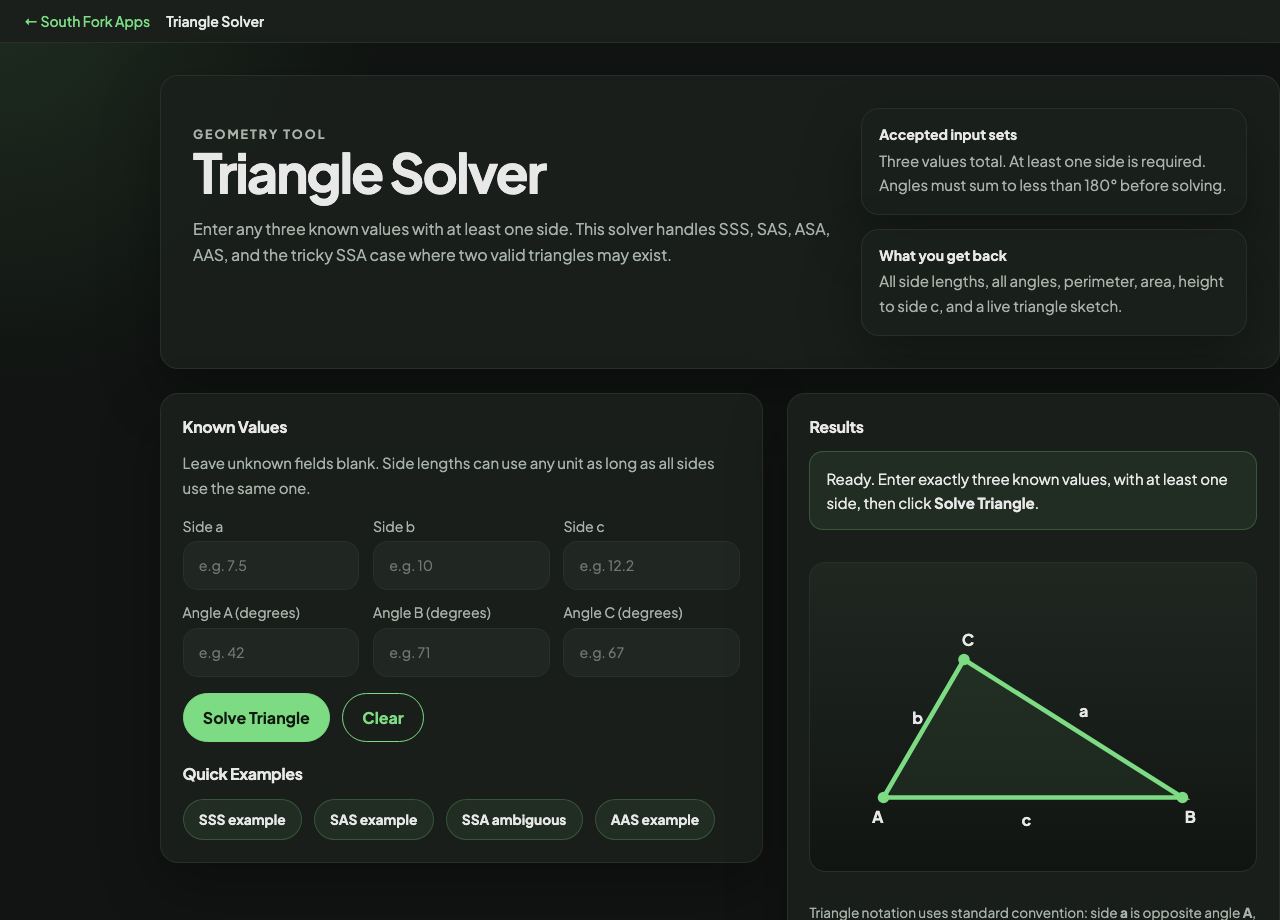
Triangle Solver interface preview
Screenshot of the live Triangle Solver interface.