Trig Reference
Unit Circle Reference
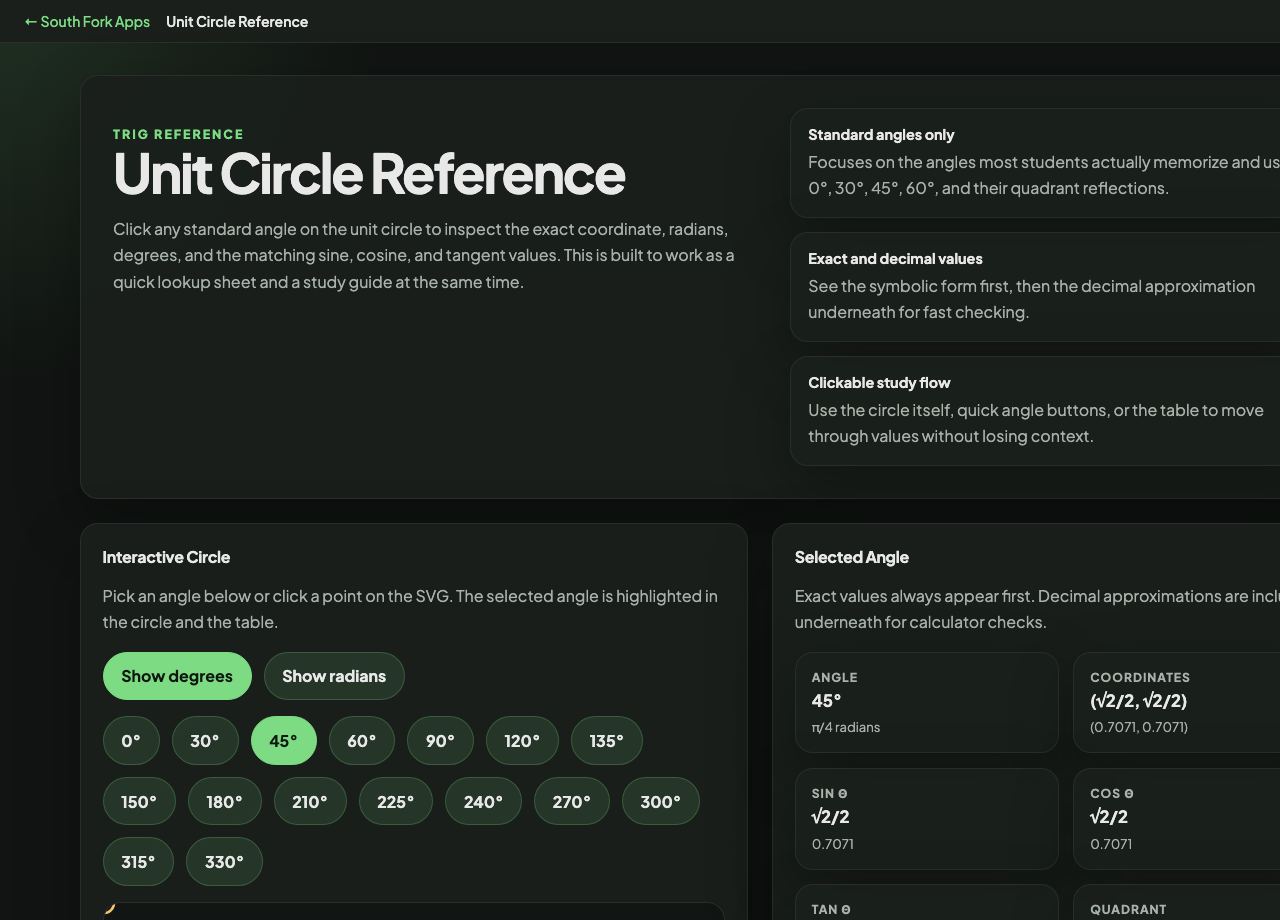
Click any standard angle on the unit circle to inspect the exact coordinate, radians, degrees, and the matching sine, cosine, and tangent values. This is built to work as a quick lookup sheet and a study guide at the same time.
Interactive Circle
Pick an angle below or click a point on the SVG. The selected angle is highlighted in the circle and the table.
| Angle | Coordinates | sin | cos | tan |
|---|
Selected Angle
Exact values always appear first. Decimal approximations are included underneath for calculator checks.
45°
π/4 radians
(√2/2, √2/2)
(0.7071, 0.7071)
√2/2
0.7071
√2/2
0.7071
1
1.0000
Quadrant I
All trig values are positive here.
About this tool
Unit Circle Reference
Unit Circle is an interactive reference for standard angles, showing degrees, radians and exact sine, cosine and tangent values at every clickable point.
How to use it
- Click any standard angle on the circle.
- Read its measure in degrees and radians.
- Read the exact sine, cosine and tangent values.
Why the coordinates are the trig values
The unit circle has radius 1 and is centred at the origin. For any angle measured from the positive x axis, the point where the angle's ray meets the circle has coordinates exactly equal to the cosine and the sine of that angle. Cosine is x, sine is y.
That is what makes the unit circle worth learning rather than memorising a table. The signs of sine and cosine in each quadrant follow from which way x and y point, and the exact values repeat in a pattern, so the whole circle reduces to a handful of facts plus symmetry.
Worked example
The 45 degree point:
- Degrees45
- Radianspi/4
- Coordinates(root 2 over 2, root 2 over 2)
Result: Cosine and sine are both root 2 over 2, which is why tangent is exactly 1 there.
When it helps
- Looking up exact trig values without a table.
- Converting between degrees and radians.
- Understanding why trig functions are periodic.
- Revising for a trigonometry exam.
Common mistakes
- Mixing up which coordinate is which. Cosine is x and sine is y, in that order, matching the alphabetical order of the axes.
- Working in degrees when the context expects radians. Most programming languages and calculus use radians throughout.
- Memorising the table instead of the quadrant symmetry, which is far more to remember and far easier to forget.