About this tool
UUID Generator
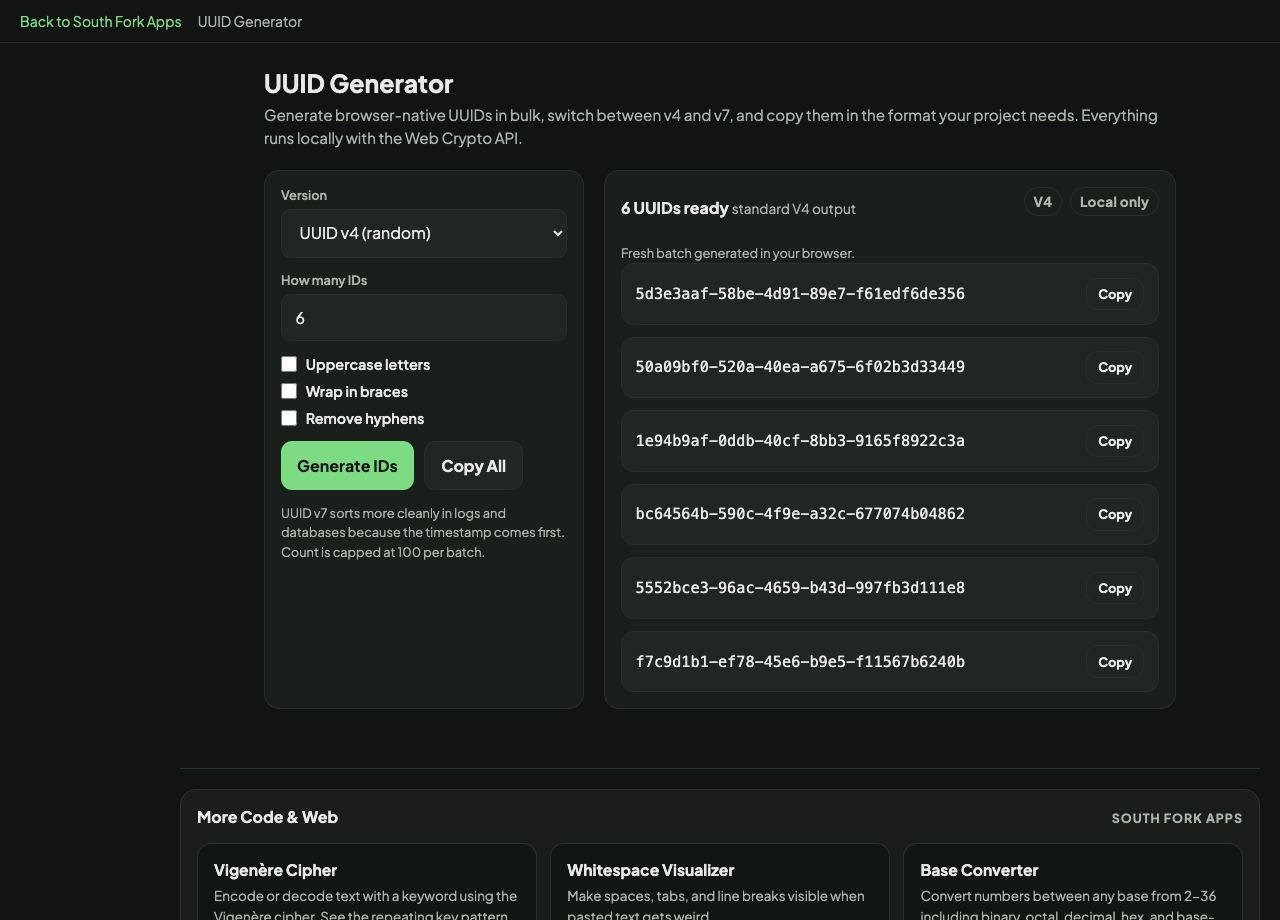
UUID Generator produces v4 or v7 identifiers in batches, with formatting options for uppercase, braces, and hyphen removal.
How to use it
- Choose UUID v4 (random) or v7 (time-ordered).
- Set how many you want.
- Toggle uppercase, braces or hyphen removal to match the format your system expects.
- Generate and copy.
v4 versus v7, and why v7 exists
A v4 UUID is 122 bits of randomness. Collisions are effectively impossible, and the values are entirely unordered, which is exactly the problem. Used as a primary key, random UUIDs scatter inserts across a database index, causing page splits and poor cache behaviour at scale.
A v7 UUID, standardised in RFC 9562, puts a millisecond timestamp in the leading bits and fills the rest with randomness. It keeps the uniqueness while sorting roughly in creation order, so inserts land together in the index. If you are choosing a UUID for a database key today, v7 is usually the better default.
When it helps
- Generating primary keys that can be created without asking a central server.
- Creating correlation IDs for tracing a request across services.
- Producing unique filenames or object keys.
- Seeding test data with realistic identifiers.
Common mistakes
- Using v4 as a clustered primary key in a large table, where the random distribution hurts insert performance.
- Assuming a UUID is secret. It is unique, not unguessable in any security sense, and v7 leaks its creation time.
- Storing UUIDs as 36-character strings when the database has a native 16-byte type, which more than doubles the storage and index size.