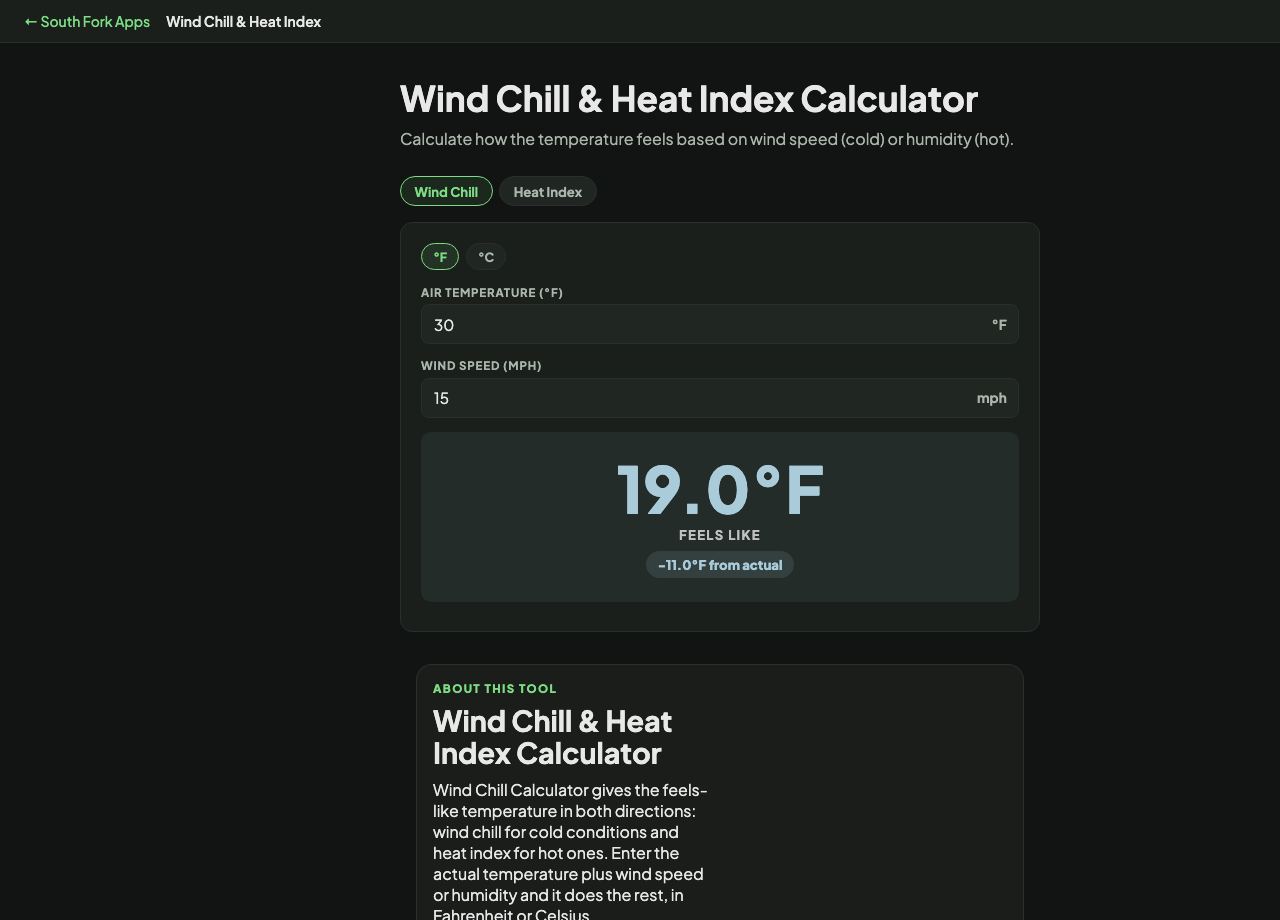
Wind Chill & Heat Index Calculator
Calculate how the temperature feels based on wind speed (cold) or humidity (hot).
Wind Chill & Heat Index Calculator
Wind Chill Calculator gives the feels-like temperature in both directions: wind chill for cold conditions and heat index for hot ones. Enter the actual temperature plus wind speed or humidity and it does the rest, in Fahrenheit or Celsius.
How to use it
- Choose Wind Chill for cold weather or Heat Index for hot.
- Enter the air temperature, then the wind speed for chill or the relative humidity for heat index.
- Switch between Fahrenheit and Celsius as needed.
Two different formulas for two different problems
Wind chill uses the 2001 US and Canadian standard: 35.74 + 0.6215T - 35.75V^0.16 + 0.4275T x V^0.16, with T in Fahrenheit and V in miles per hour. It models how fast moving air strips the thin layer of warm air off exposed skin.
Heat index solves the opposite problem. In hot weather the danger is that high humidity stops sweat evaporating, so the body cannot shed heat. It is a function of temperature and relative humidity, and wind speed barely matters.
Worked example
A cold, windy day using the default inputs:
- Air temperature30 F
- Wind speed15 mph
Result: A wind chill of about 19 F. The air is 30 degrees, but exposed skin loses heat as if it were 19.
When it helps
- Deciding what to wear before going out in wind.
- Judging frostbite risk, which depends on wind chill rather than air temperature.
- Checking whether outdoor work or exercise is safe.
- Understanding why a still 20 degree day feels warmer than a windy 30 degree one.
Common mistakes
- Applying wind chill outside its valid range. The formula is defined for temperatures at or below 50 F and wind above 3 mph.
- Using wind chill for objects. It describes heat loss from exposed skin. A parked car cools to the air temperature, not to the wind chill.
- Ignoring humidity in heat. At 95 F the difference between dry and humid air is the difference between uncomfortable and dangerous.